
Famous Red Sea Wreck Dives: SS Thistlegorm and Salem Express
The Red Sea has many wrecks, but two names come up again and again: SS Thistlegorm and Salem Express. They are both famous, but they are not the same kind of dive.
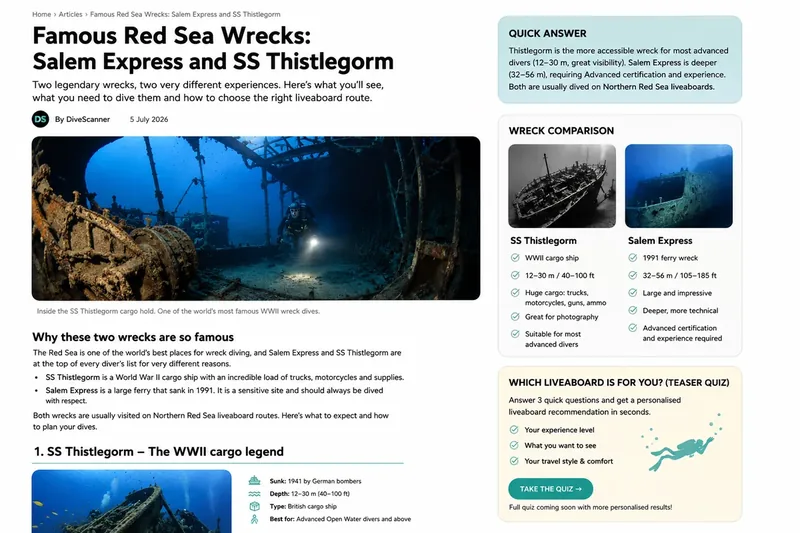
Quick answer
The SS Thistlegorm is the classic Red Sea wreck liveaboard dive for divers who want history, cargo holds, motorcycles, trucks and a clear northern route. Salem Express is a very different site. It is a passenger ferry wreck near Safaga with a tragic history, and it should be approached with respect rather than treated as a normal attraction.
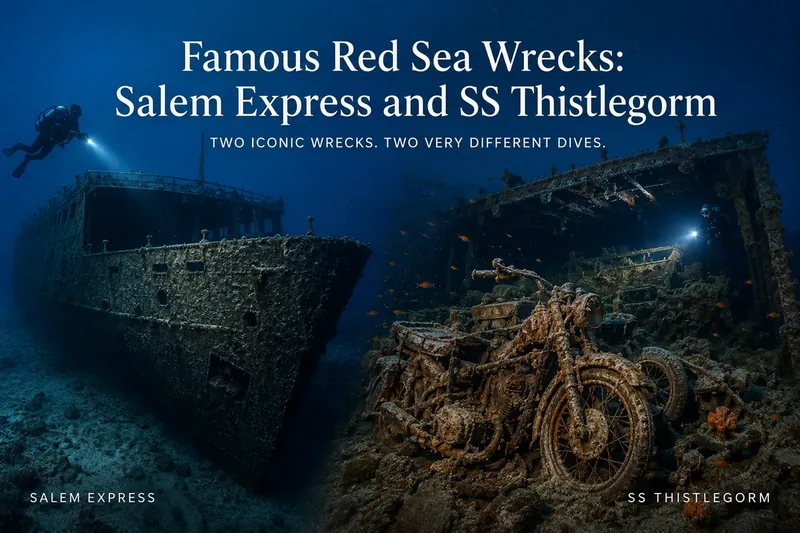
SS Thistlegorm and Salem Express – two of the most famous wreck dives in the Red Sea.
Quick comparison
| Wreck | Area | Typical depth | Best route type | Diver level |
|---|---|---|---|---|
| SS Thistlegorm | Northern Red Sea, near the Straits of Gubal | About 16 - 32 m depending on section | North and Wrecks, Best of Red Sea, Sharm or Hurghada northern routes | Advanced Open Water recommended. Wreck training useful for penetration. |
| Salem Express | Near Safaga, Hyndman Reef area | About 10 - 32 m depending on section | Safaga routes, selected southern or wreck-focused itineraries | Advanced Open Water recommended. Respectful non-penetration approach preferred. |
Why these two wrecks are not the same
It is easy to group famous wrecks together, but that is not useful for divers. The SS Thistlegorm is usually discussed as a war wreck and underwater cargo site. Divers go there to see a World War II ship, vehicles, equipment and a large structure that can take more than one dive to understand.
Salem Express is different. It is a more recent passenger ferry tragedy. Many people died when the vessel sank, and the wreck is still emotionally sensitive for Egyptian communities, divers and guides. It should never be promoted with the same tone used for a reef or a cargo wreck.
The Salem Express is not just a dive site. It is connected to real families, loss and memory. Do not touch personal items, do not remove anything, do not joke about the wreck and do not enter spaces unless the guide, local rules and your training clearly support it. Many divers choose to view it from the outside only.
SS Thistlegorm: the classic Red Sea wreck route
The SS Thistlegorm was a British cargo steamship built in Sunderland in 1940 and sunk by German aircraft in October 1941. It was carrying wartime supplies, and the cargo is the reason the wreck became so well known among divers.
The site is large. Divers can see sections of the ship, rail equipment, trucks, motorcycles, boots and other cargo. This makes the Thistlegorm feel like an underwater museum, but it is still a real wreck with depth, metal edges, silt, current and overhead areas.
Most liveaboard divers visit the Thistlegorm on northern Red Sea wreck routes. These routes often combine the wreck with Ras Mohammed, the Straits of Gubal, Abu Nuhas and other northern sites. It is one of the strongest routes for divers who want a practical first wreck-focused liveaboard in Egypt.
Who should dive the Thistlegorm?
Advanced Open Water is strongly recommended. The wreck is not extremely deep compared with some technical wrecks, but many important sections sit around the deeper part of recreational diving. Current can also be present, and the site can be busy.
If you want to enter cargo holds, do not treat that as casual sightseeing. You need excellent buoyancy, torch control, gas awareness and a guide who understands the wreck. A wreck specialty or proper overhead training is useful if penetration is part of the plan.
Look for itineraries named North and Wrecks, Wrecks and Reefs, Best of the Red Sea or northern Red Sea wreck routes. Check the itinerary text. A Red Sea liveaboard does not automatically include the Thistlegorm.
Salem Express: a wreck that needs careful wording
The Salem Express was a passenger ferry that sank in December 1991 after striking a reef near Safaga. It was carrying passengers returning from Jeddah, and the loss of life was severe. Because of this, many divers, guides and operators treat the site with a very different level of care.
The wreck lies on its side and is shallow enough in places to be accessible to recreational divers, but that does not make it a simple dive. The emotional weight of the site matters. Personal items may still be seen. For many divers, the correct approach is to observe from outside, keep distance and avoid any behaviour that feels intrusive.
Salem Express is usually associated with Safaga diving rather than standard northern wreck liveaboards. Some liveaboards or special routes may include it, but many divers visit from Safaga-based boats. If the Salem Express is important to your trip, check the route carefully before booking.
Who should dive Salem Express?
This is not a beginner sightseeing wreck. Advanced Open Water, calm buoyancy and emotional maturity are recommended. The dive should be briefed clearly. Divers should understand what the site represents before entering the water.
Penetration is not something to chase here. Even when physical access is possible, that does not mean it is appropriate. The best dive plan is usually a controlled exterior tour with no touching, no souvenir behaviour and no disturbance of the wreck.
Which wreck is better for your liveaboard?
| Your priority | Better fit | Why |
|---|---|---|
| Classic Red Sea wreck route | SS Thistlegorm | Commonly included on northern wreck liveaboards and easier to combine with other famous sites. |
| War history and cargo | SS Thistlegorm | Vehicles, equipment and cargo areas make it one of the most recognisable wreck dives in Egypt. |
| Quiet, reflective dive | Salem Express | More emotional and sensitive. Best for divers who understand the history and accept a respectful approach. |
| First wreck liveaboard | SS Thistlegorm route | Better suited to a structured wreck and reef itinerary with several other dive options. |
| Beginner liveaboard | Neither as a main goal | Start with reefs, shallow wrecks and easier routes before planning these dives. |
Certification, depth and safety
Both wrecks sit within recreational diving limits for trained divers, but depth is only one part of the decision. The real questions are current, visibility, overhead areas, diver traffic, buoyancy and comfort around wreck structures.
Nitrox is useful on Red Sea liveaboards because dives are repetitive. It can help manage no-decompression limits, especially on routes where the same day includes deeper wreck profiles and reef dives. It does not replace depth training or gas planning.
Good wreck behaviour is simple. Keep your fins away from silt and fragile growth. Do not pull on the wreck. Do not take objects. Do not force swim-throughs. If the guide changes the plan because of current or visibility, accept it.
Quick teaser: which Red Sea wreck route fits you?
This is a short planning teaser, not a full recommendation engine. Tick the statements that sound like you – up to three, in any order.
You can tick up to three.
Final recommendation
If this is your first Red Sea wreck-focused liveaboard, start with a northern route that includes the SS Thistlegorm and other wrecks or reefs. It gives you a stronger overall trip and a clearer liveaboard structure.
If you want to dive the Salem Express, choose the operator and route carefully. Make sure the briefing is respectful, the plan is conservative and the dive is not treated as entertainment. Some divers will feel that the right choice is not to dive it at all. That is also a valid decision.
Planning Red Sea wreck diving? Use DiveScanner to compare route style, certification level and realistic itinerary fit before booking.
Compare liveaboardsFAQ
Can you dive the SS Thistlegorm on a liveaboard?
Yes. It is commonly included on northern Red Sea wreck liveaboards, but you still need to check the exact itinerary. Weather, route changes and operator planning can affect the final dive schedule.
Is the Salem Express suitable for beginners?
No, not as a first wreck goal. Parts of the wreck are shallow, but the site has emotional, ethical and safety considerations. Advanced Open Water, good buoyancy and a respectful approach are recommended.
Do you need a wreck specialty?
For exterior viewing, not always. For penetration, a wreck specialty or proper overhead training is strongly recommended. Penetration should never be improvised on a liveaboard.
Can one liveaboard include both wrecks?
Some routes may combine northern wrecks with Safaga or wider Red Sea itineraries, but many do not. Check the route map and day-by-day itinerary before booking.
Related liveaboard diving guides
- Advanced liveaboard routes: certification, depth and insurance checks
- Best time to book a Red Sea liveaboard by season and price
- What is a liveaboard and how to choose the right boat
Source and sensitivity note
Historical accounts and depth figures vary slightly between dive operators, wreck guides and historical sources. This article uses conservative planning ranges and avoids sensational wording around the Salem Express because of the civilian loss of life.