
Maldives Diving Season: When to Go for Mantas and Clear Water
8 July 2026
The Maldives is not one simple diving season. It has calm months, plankton months, manta months, whale shark months, shoulder months and expensive holiday months.
For liveaboard diving, the best month depends on what you want most: visibility, calm seas, mantas, whale sharks, sharks, price, or a route that actually fits your level.
Quick answer
For the clearest water and calmer sea conditions, January to April is usually the strongest Maldives diving window. For manta rays and whale sharks, August to November is often highlighted. For liveaboard diving, January to May is a strong route-planning window, but the best choice still depends on the atoll, monsoon direction, itinerary and your diver level.
Quick facts
| Best visibility | Usually January to April, during the dry northeast monsoon period. |
|---|---|
| Best big-life focus | August to November is often highlighted for manta rays and whale sharks, but sightings are never guaranteed. |
| Strong liveaboard window | January to May is commonly recommended for Maldives liveaboard diving because sea conditions are usually good. |
| Water temperature | The Maldives is warm year-round, usually around 26-30°C / 80-86°F. |
| Dive style | Drift dives, thilas, channels, cleaning stations, reef sharks, manta sites, whale shark routes and current-dependent itinerary planning. |
Why timing matters for Maldives liveaboard diving
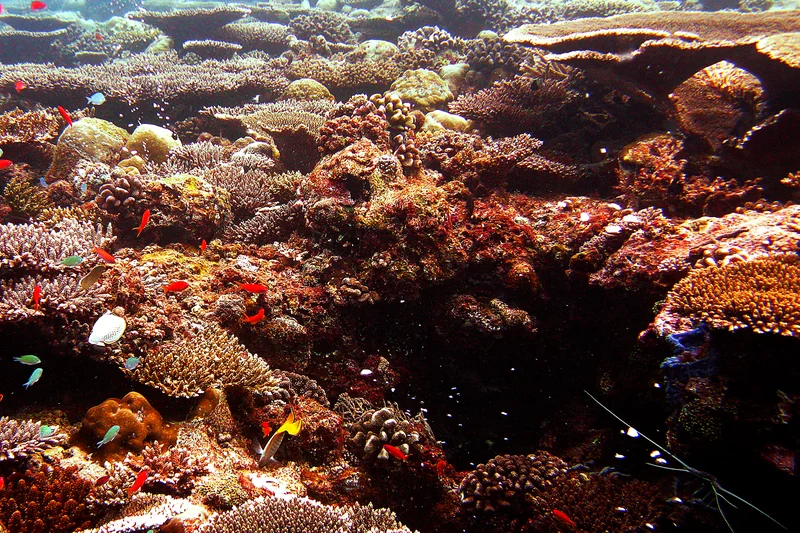
Maldives liveaboard diving is shaped by the monsoons. The northeast monsoon usually brings drier weather, calmer seas and better visibility. The southwest monsoon can bring more wind, rain and plankton, but plankton is exactly why manta rays and whale sharks can become more active in some areas.
This is why a simple answer like “go in February” or “go in August” is not enough. February may give you beautiful visibility. August may give you stronger big-animal potential. A central atolls itinerary is not the same as a southern route, and a beginner-friendly trip is not the same as a channel-heavy itinerary with stronger current.
PADI notes that the Maldives can be dived at any time, with water temperatures around 80-86°F / 26-30°C. It also highlights January to April for great visibility and August to November for manta rays and whale sharks. PADI Travel adds that many Maldives areas are only accessible by diving cruise and that most Maldives liveaboard itineraries are around 7-10 days.
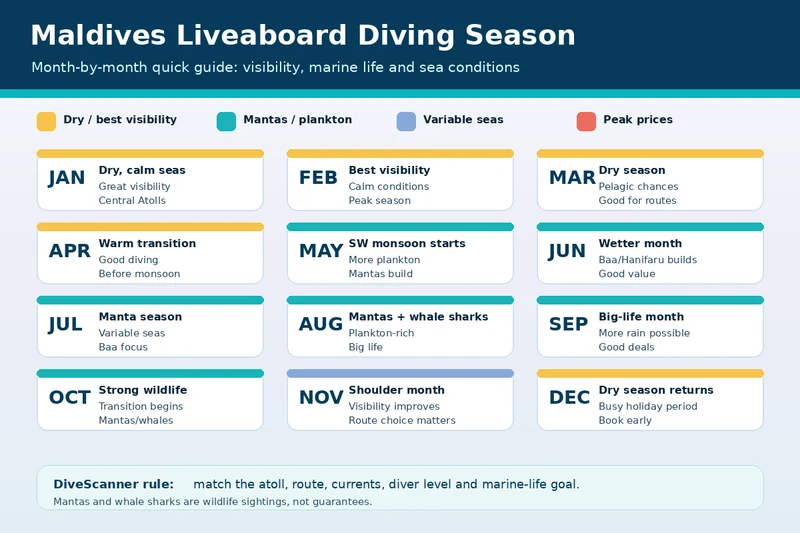
Month-by-month Maldives diving guide
| Month | What to expect | Best for | Watch out for |
|---|---|---|---|
| January | Dry-season conditions, calmer seas and strong visibility. | First Maldives liveaboard, reef sharks, central atolls, photographers. | Peak-season prices and availability pressure. |
| February | Often one of the clearest and driest months. | Visibility, comfortable liveaboard diving, confident beginners on suitable routes. | Book early, especially for popular boats. |
| March | Still strong dry-season diving with good route options. | Central atolls, pelagics, thilas and channel dives. | Currents can still be part of the experience. |
| April | Warm transition month before the southwest monsoon. | Divers who want good weather with slightly less peak-season pressure. | Conditions can start to shift by the end of the month. |
| May | Southwest monsoon begins; more plankton and more variable weather. | Manta-focused planning, better prices, divers who accept changing conditions. | More rain and rougher crossings are possible. |
| June | Wetter period, but Baa Atoll and Hanifaru Bay activity starts building. | Manta season planning, good-value liveaboard trips. | Visibility may drop because plankton increases. |
| July | Stronger manta potential in the right areas, especially around Baa Atoll. | Manta rays, plankton action, divers who care more about wildlife than perfect visibility. | Sea conditions can be less settled. |
| August | Often highlighted for mantas and whale sharks. | Big animal encounters and plankton-driven marine life. | Not the best month if your only priority is clear water. |
| September | Still strong for marine life, with more rain possible. | Divers looking for wildlife and lower crowd pressure. | Weather flexibility matters. |
| October | Good wildlife month and the end of the stronger southwest monsoon period. | Mantas, whale sharks and value-focused liveaboard diving. | Some routes may still have variable seas. |
| November | Shoulder month. Conditions begin moving back toward the dry season. | Divers who want big-life potential with improving visibility. | Itinerary choice matters more than the month alone. |
| December | Dry season returns and holiday demand rises. | Warm water, better weather, festive liveaboard trips. | Christmas and New Year can be expensive and book out early. |
Best time for manta rays in the Maldives
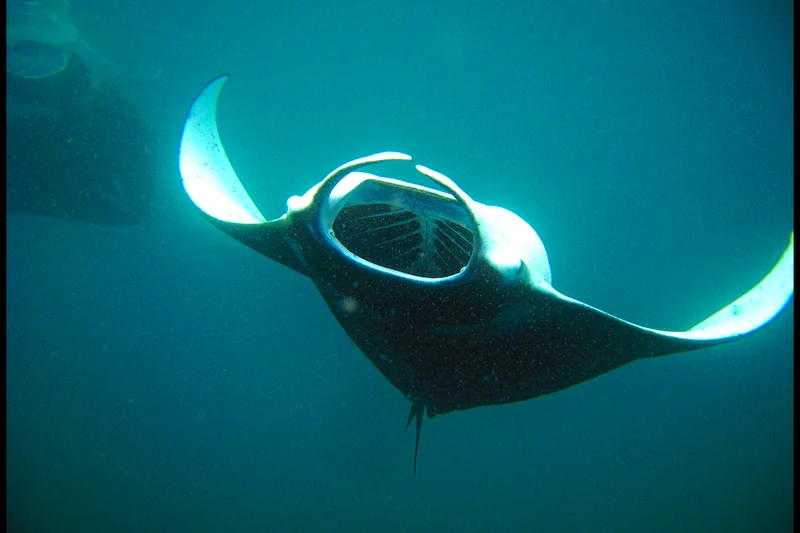
Manta rays can appear in different atolls at different times, but the strongest manta planning usually follows plankton and monsoon movement. PADI highlights August to November as a strong period for manta rays and whale sharks in the Maldives.
Hanifaru Bay in Baa Atoll is one of the most famous manta places in the Maldives, but it is important to understand the rules: Hanifaru is mainly a snorkelling experience, not a normal scuba-diving site. If a liveaboard advertises Baa Atoll or Hanifaru, check exactly what is included and whether the route is timed around the right season.
Best time for whale sharks in the Maldives
South Ari Atoll is the key Maldives name for whale sharks. PADI’s South Ari guide says manta rays and whale sharks can be seen year-round there, with January to March often strong for weather and visibility.
For a liveaboard diver, this means you should not only ask “what month is best?” Ask whether the itinerary actually goes near South Ari, how many days are spent there, and whether whale shark searches are part of the route or just a vague marketing promise.
Best months by diver type
| Diver type | Best months to consider | Why |
|---|---|---|
| First Maldives liveaboard | January to April | Better visibility, calmer seas and more comfortable conditions. |
| Manta-focused diver | June to October, especially Baa/Hanifaru planning | Plankton builds and manta activity can be stronger in the right areas. |
| Whale shark-focused diver | South Ari year-round; August to November often promoted for big life | Route choice matters more than country-level season. |
| Photographer | January to April | Clearer water and more reliable light. |
| Budget/value traveller | May, June, September, October, November | More variable weather, but often better value. |
| Advanced/current-loving diver | Depends on route | Channel dives and southern routes can be excellent but should match logged dives and comfort in current. |
Should beginners choose a Maldives liveaboard?
Yes, but not every route.
A beginner-friendly Maldives liveaboard should avoid selling the trip only with whale shark photos and shark hype. The better question is whether the route matches the diver: number of dives, current, depth, night dives, drift comfort, group size and how clearly the crew explains the plan.
If you are new to liveaboard diving, start with a central atolls route in calmer months, especially between January and April. If you want southern routes, channels or stronger pelagic diving, build more experience first.
How to choose the right Maldives month
Use this order:
- Choose your main goal: visibility, mantas, whale sharks, sharks, price or easier conditions.
- Choose the atoll or route, not only the country.
- Check if the itinerary fits your certification and logged dives.
- Look at the month, but accept that wildlife is never guaranteed.
- Check transfers, domestic flights and whether the route starts from Malé or farther south.
This is where DiveScanner can be stronger than a normal booking page. A diver should not only compare boats. A diver should compare routes, season, diver level and what the trip actually asks from them underwater.
Compare Maldives liveaboard diving trips
Use DiveScanner to compare liveaboard diving routes by destination, season, marine life, certification level and itinerary difficulty.
Featured Maldives liveaboards
A few Maldives liveaboards to start with, each shown with real, current prices from every provider that sells it:
Final advice
The best time to dive in the Maldives is not one month for everyone.
If you want calm seas and visibility, look at January to April. If you want mantas and whale sharks, pay attention to August to November and the right atolls. If you are new to liveaboard diving, do not let big-animal marketing push you into a route that is too advanced.
Choose the month. Then choose the route. Then check if the trip fits the diver you actually are.
FAQ
What is the best time to dive in the Maldives?
January to April is usually best for visibility and calmer dry-season conditions. August to November is often highlighted for manta rays and whale sharks.
What is the best time for Maldives liveaboard diving?
January to May is a strong liveaboard diving window because sea conditions are usually good. May to November can be more variable but can also be strong for big-animal encounters.
Can you see whale sharks in the Maldives all year?
South Ari Atoll is known for year-round whale shark sightings, but sightings depend on route, conditions and wildlife behaviour. Do not treat any sighting as guaranteed.
When is manta season in the Maldives?
It depends on the atoll. August to November is often highlighted for manta rays and whale sharks, while Baa Atoll and Hanifaru Bay are strongly associated with the southwest monsoon period.
Is the Maldives suitable for beginner liveaboard divers?
Some central atolls routes can be suitable for confident beginners, especially in calmer months. Channel-heavy, southern or advanced shark-focused routes need more experience.
Sources and planning notes
This guide uses current destination information from PADI Travel's Maldives liveaboard guide, PADI's Maldives diving guide, PADI's South Ari Atoll guide and Hanifaru Bay Marine Protected Area visitor-rule references. Conditions and sightings change. Always check the exact route, month, operator notes, local regulations and diver-level requirements before booking.