
Nitrox on a Liveaboard: Is It Worth Paying For?
11 July 2026
If you are doing a liveaboard, Nitrox is one of the first upgrades people will try to sell you. Sometimes it is worth it. Sometimes it is included. Sometimes divers pay for it and still do not really know what it is doing.
The short version: Nitrox can be very useful for liveaboard diving, but only if you are certified, you analyse your own tank, you set your computer correctly, and you respect the depth limit of the gas in your cylinder.
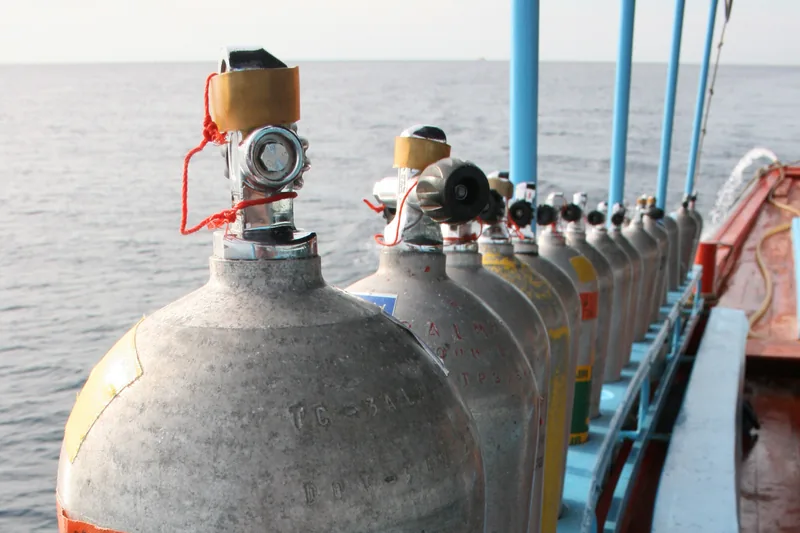
Nitrox cylinders on a dive boat. Photo: Eli Duke, CC BY-SA 2.0, via Wikimedia Commons.
Quick answer
Yes, Nitrox is usually worth it on a liveaboard if you are certified and doing repetitive dives. It gives you more oxygen and less nitrogen than normal air. That can help with no-decompression limits and can make multi-dive days more manageable. It does not let you dive deeper. In many cases it means you must stay shallower.
Quick facts
| Question | Answer |
|---|---|
| What does Nitrox stand for? | Nitrox means nitrogen and oxygen. In diving, it usually means enriched air Nitrox, a gas with more oxygen and less nitrogen than normal air. |
| Normal air | About 21% oxygen and 79% nitrogen. |
| Common recreational Nitrox mixes | EAN32 and EAN36, meaning 32% oxygen or 36% oxygen. The tank must still be analysed every time. |
| Main liveaboard benefit | Less nitrogen exposure or longer no-decompression time on repetitive dives. |
| Main safety limit | Maximum operating depth, called MOD. |
| Common mistake | Thinking Nitrox lets you go deeper. It does not. |
What is Nitrox?
Nitrox is a breathing gas made of nitrogen and oxygen. Recreational divers usually mean enriched air Nitrox, which has a higher oxygen percentage than normal air.
Normal air has about 21% oxygen. Recreational Nitrox usually has more than that, commonly 32% or 36%. PADI describes recreational Nitrox as enriched air with oxygen levels between 22% and 40%, instead of normal air at 21% oxygen. PADI
That extra oxygen replaces part of the nitrogen. This is the whole point.
More oxygen. Less nitrogen.
That sounds simple, but it changes the dive plan.
Why nitrogen matters in your body
When you dive, pressure increases. The deeper you go and the longer you stay, the more nitrogen your body absorbs from the breathing gas. Your dive computer watches this because too much nitrogen loading can push you toward decompression sickness risk.
Nitrox reduces the nitrogen percentage in the tank. That means, for the same depth and time, your body takes in less nitrogen than it would on air.
This is why Nitrox is useful on liveaboards. A liveaboard is not one dive and a coffee. It is often three or four dives a day, then the same again tomorrow, and again the next day.
One easy dive is one thing. Repetitive diving for a week is different.
Does Nitrox make you less tired?
Many divers say they feel less tired when they dive Nitrox, especially on a full liveaboard schedule. I understand why people say it. After several days of diving, the difference can feel real.
But I will not sell it as magic oxygen recovery. That is too simple.
The stronger explanation is this: with Nitrox, you can reduce nitrogen exposure if you keep the same profile you would have done on air. Less decompression stress can make the week feel easier. DAN says it is reasonable to use oxygen-enriched mixtures to help minimise decompression stress, but also points out that tiredness claims are not a free pass to ignore oxygen toxicity and MOD. DAN
So yes, many divers feel better with Nitrox.
No, that does not mean the tank is giving you superpowers.
Why Nitrox helps on a liveaboard
Liveaboard diving is where Nitrox makes the most sense because the diving is repetitive. You are not just planning one dive. You are planning a whole week of nitrogen exposure.
Nitrox can help in two main ways:
- You can use it conservatively and keep the same dive time as air, but with less nitrogen loading.
- You can use it to extend your no-decompression limit at the same depth, if your gas consumption and the dive plan allow it.
DAN explains the trade clearly: Nitrox can lower DCS risk or extend bottom time, but you do not get both at the same time if you push the Nitrox no-decompression limit. DAN
This matters because some divers turn every tool into a reason to push harder. That is not the point.
On a liveaboard, I would rather see Nitrox used to protect the week than to squeeze every last minute out of every dive.
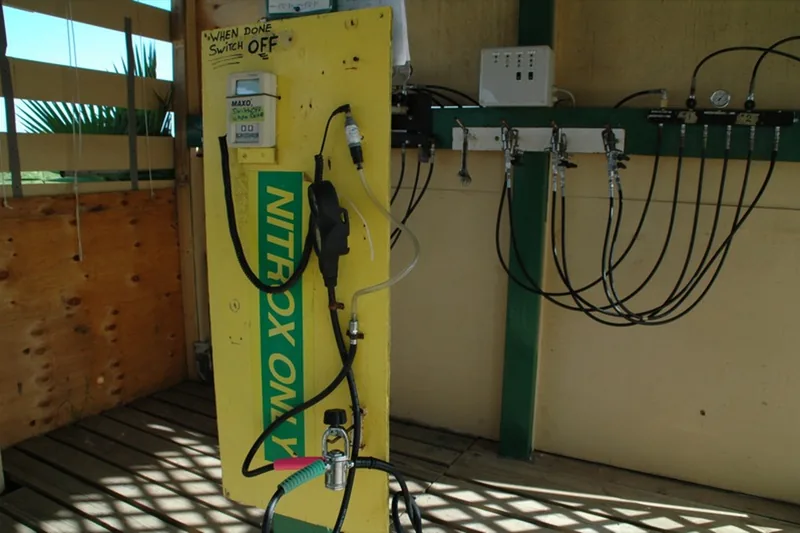
A Nitrox measuring station. Photo: Chika Watanabe, CC BY 2.0, via Wikimedia Commons.
The common mistake: Nitrox does not mean deeper
This is the mistake that needs to die.
Nitrox does not let you go deeper.
It usually means the opposite. You must stay shallower than you could on air, because the higher oxygen percentage reaches unsafe oxygen partial pressure sooner as depth increases.
The limit is called MOD: maximum operating depth.
For example, DAN gives these MOD examples using a 1.4 ATA oxygen partial pressure limit:
| Gas | Approximate oxygen | Example MOD using 1.4 ATA |
|---|---|---|
| Air | 21% | Beyond normal recreational limits |
| EAN32 | 32% | About 34 m / 112 ft |
| EAN36 | 36% | About 29 m / 95 ft |
Source: Divers Alert Network. Always follow your agency training, dive computer, local rules and the actual analysed mix in your tank.
Do not follow an air diver deeper than your Nitrox MOD
This is where liveaboard group diving can create problems. One diver is on air, another is on EAN32, another is on EAN36, and everyone listens to the same briefing. Your limit is not the guide's limit. Your limit is your gas, your computer and your training.
What happens if you go too deep with Nitrox?
The oxygen percentage in the tank stays the same, but pressure increases as you descend. That means the partial pressure of oxygen increases with depth.
Too much oxygen under pressure can cause central nervous system oxygen toxicity. DAN lists possible signs such as tunnel vision, ringing in the ears, confusion, nausea, twitching and convulsion. A convulsion underwater is one of the scenarios divers must take seriously. DAN
This is why the MOD is not a suggestion.
If your mix says your maximum is 29 metres, then 31 metres is not almost fine. It is past the plan.
Recreational Nitrox limits
Most recreational Nitrox training works within enriched air up to 40% oxygen. The common mixes on liveaboards are usually 32% and 36%, but you do not assume. You analyse.
For recreational diving, the key limits are:
- stay within no-decompression limits
- stay within the MOD of the analysed mix
- stay within your certification and experience
- stay within the route's depth and current demands
- set your dive computer to the correct oxygen percentage
- track oxygen exposure across repetitive dives if your computer requires it
For most normal liveaboard guests, Nitrox is not technical diving. But it is still a different gas. Treat it properly.
When Nitrox is worth it on a liveaboard
Nitrox is usually worth it when:
- you are doing three or four dives a day
- you are diving for several days in a row
- the dives are mostly in the 18 to 30 metre range
- your no-decompression limit ends the dive before your air does
- the boat includes Nitrox in the price
- you want a more conservative week of liveaboard diving
This is why you see Nitrox offered on routes like the Red Sea, Maldives, Thailand, Bahamas, Raja Ampat and Komodo. Liveaboards are built around repetitive diving, and repetitive diving is exactly where Nitrox becomes useful.
When Nitrox is not the priority
Nitrox is not the first fix for every diver.
If a diver is stressed, overweighted, breathing fast, fighting buoyancy or finishing every dive low on gas after 30 minutes, Nitrox will not solve the real problem.
That diver needs comfort, buoyancy, breathing control, better weighting and maybe an easier route.
Nitrox helps with nitrogen. It does not fix panic, bad trim, bad finning, poor judgement or ego.
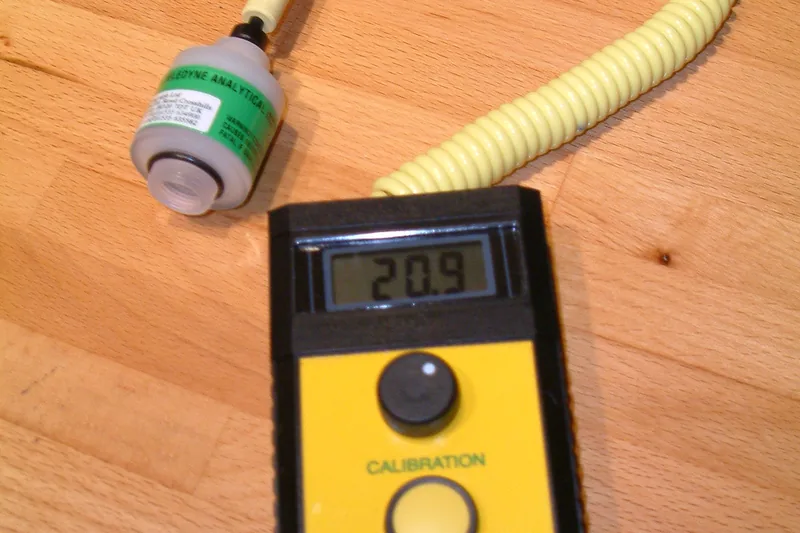
Oxygen analyser used for checking breathing gas. Photo: Mark.murphy, public domain, via Wikimedia Commons.
Before every Nitrox dive
This is the part I care about most.
Before every Nitrox dive, you check your own tank.
Not what the sticker says. Not what the crew says from memory. Not what your buddy has. Your tank. Your reading.
Nitrox checklist
- Analyse the tank yourself or watch the analyser clearly.
- Confirm the oxygen percentage.
- Write or confirm the mix on the tank label if the boat uses labels.
- Confirm the MOD.
- Set your dive computer to the analysed mix.
- Check that your buddy has done the same.
- Follow the shallower limit if the group uses different gases.
DAN's Nitrox safety article makes the same point clearly: safe Nitrox diving depends on clear labelling, gas verification and planning the maximum operating depth. DAN
Questions to ask before booking
| Question | Why it matters |
|---|---|
| Is Nitrox included or extra? | Some boats include it. Some charge per tank or per package. |
| What mix do you usually provide? | Many boats use around 32%, but every tank still needs analysing. |
| Are oxygen analysers available? | You need to check your mix before diving. |
| Can I take the Nitrox course onboard? | Useful if you are not certified yet, but confirm before booking. |
| Are the planned depths suitable for Nitrox? | Deep dives may make certain mixes unsuitable. |
| Do guides include MOD in the briefing? | A good briefing should talk about gas, depth and limits. |
My answer
Should you dive with Nitrox on a liveaboard?
Yes, if you are certified, the route makes sense for it, and you are prepared to do the checks properly.
Use Nitrox because liveaboard diving is repetitive.
Use it because less nitrogen can help your dive week feel more controlled.
Use it because it can give you more no-decompression time at the right depths.
But do not use it as an excuse to switch your brain off.
Analyse your tank. Set your computer. Respect the MOD. Do not follow someone deeper just because they look confident.
Nitrox is a good tool.
It is not permission to be careless.
Plan a liveaboard with the right gas and the right route
Compare liveaboard diving trips by destination, route, season, diver level, Nitrox availability and marine life.
Compare liveaboardsSources and image credits
- PADI: What Is Nitrox?
- PADI: Enriched Air Nitrox benefits
- DAN: Nitrox
- DAN: Air, Nitrox and Fatigue
- DAN: Oxygen Toxicity
- Cover image: Eli Duke, Nitrox cylinders on a dive boat, Koh Tao, Thailand, CC BY-SA 2.0.
- Analyzer station image: Chika Watanabe, Nitrox analyzer, CC BY 2.0.
- Oxygen analyser image: Mark.murphy, Diving oxygen analyser, public domain.
Frequently asked questions
Should I dive with Nitrox on a liveaboard?
Yes, if you are certified, the dives fit the gas mix and you analyse your own cylinder. Nitrox is useful on liveaboards because repetitive diving can increase nitrogen loading over several days.
Does Nitrox let you dive deeper?
No. Nitrox usually gives a shallower maximum operating depth than air because the higher oxygen percentage reaches oxygen partial pressure limits sooner.
What does Nitrox stand for?
Nitrox stands for nitrogen and oxygen. In recreational diving it usually means enriched air with more oxygen and less nitrogen than normal air.
What are common recreational Nitrox mixes?
Common recreational Nitrox mixes are EAN32 and EAN36, meaning 32 percent oxygen or 36 percent oxygen. The exact mix must always be analysed before the dive.
Can Nitrox reduce tiredness after diving?
Many divers report feeling less tired with Nitrox, especially during repetitive diving, but this should be treated carefully. The stronger reason to use Nitrox is reduced nitrogen exposure or longer no-decompression time, not a guaranteed energy boost.