
Where can divers see nudibranchs
5 September 2026
Nudibranchs are small marine molluscs that divers search for on reefs, walls, rubble slopes, kelp, black sand and tidepool habitats. This guide explains where to look, what types to know, how big they are, what depths and temperatures matter, and how to identify them without touching the animal. It is not a sighting promise.
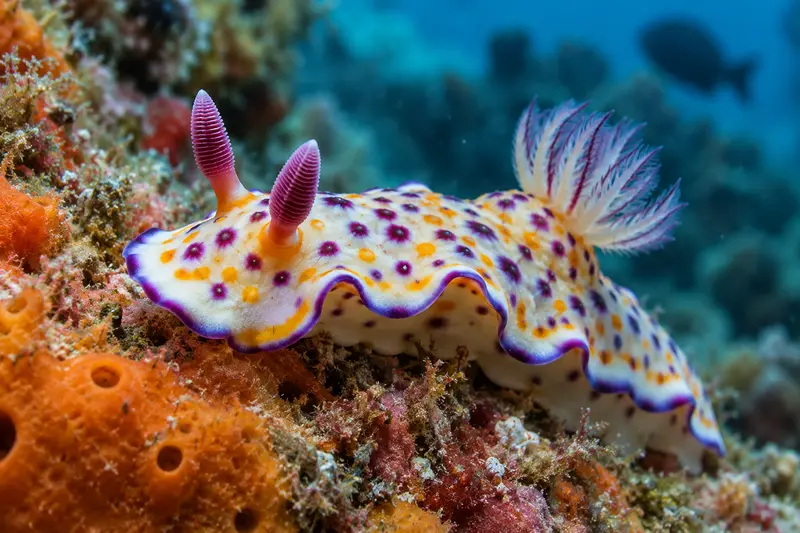
For species-level identification, use a regional field guide and photos taken from more than one angle.
Quick answer
Start with macro and muck diving areas in the Indo-Pacific, including Lembeh Strait, Anilao, Bali and Tulamben, Raja Ampat and Komodo. Nudibranchs also live in temperate seas and tidepools, so they are not only tropical animals. On a dive trip, the search method is slow movement, good buoyancy, a guide who knows local food sources, and careful inspection of sponges, hydroids, algae, bryozoans, soft corals, rubble and shaded reef surfaces.
What are nudibranchs?
Nudibranchs are marine gastropod molluscs in the order Nudibranchia. The World Register of Marine Species lists Nudibranchia under Mollusca, Gastropoda and Heterobranchia. The name is commonly explained as "naked gills" because many nudibranchs lack an adult protective shell and carry exposed gills or gill-like structures.
Not every colorful sea slug is a nudibranch. Some popular subjects, including sacoglossans, sea hares, headshield slugs and sidegill slugs, belong to other sea slug groups. The distinction matters when writing a dive log, uploading a sighting, or trying to match a photo to a field guide.
Smithsonian Ocean says there are about 3,000 species, with two main types divers should know: dorids and aeolids. Most are small. National Geographic puts the usual size range at about 0.25 to 12 inches (6 millimetres to 31 centimetres). Smithsonian notes many are around two centimetres.
Main types divers should know
| Type | Common diver clue | Identification note |
|---|---|---|
| Dorid nudibranchs | A smoother or broader body with a feather-like gill tuft toward the rear. | The gill plume is a strong clue, but species ID still needs color pattern, rhinophores, mantle shape, location and a regional guide. |
| Aeolid nudibranchs | Rows of finger-like cerata on the back instead of a rear gill rosette. | Cerata can be used for gas exchange and may contain defensive material taken from prey. |
| Other cladobranch forms | Branched, ridged or unusual body shapes that do not look like the classic smooth dorid form. | These are easy to misidentify from one photo. Use more than color. |
| Sea slugs that are not nudibranchs | Shell remnants, side gills, head shields, leaf-like bodies, or sacoglossan traits. | Do not log every sea slug as a nudibranch. "Leaf sheep" is a common example of a sea slug that is not a nudibranch. |
How big are nudibranchs?
National Geographic lists nudibranch size from 0.25 inches to 12 inches. Smithsonian Ocean notes that nudibranchs often reach only about two centimetres. For divers, that means many sightings are easy to miss unless the dive pace is slow and the search area is small.
A useful field habit is to search at two scales. First scan a hand-sized patch for obvious color and shape. Then inspect smaller features such as sponge pores, hydroid stems, algae edges and coral rubble. Many animals that look like a dot at swimming speed become clear once the diver stops moving.
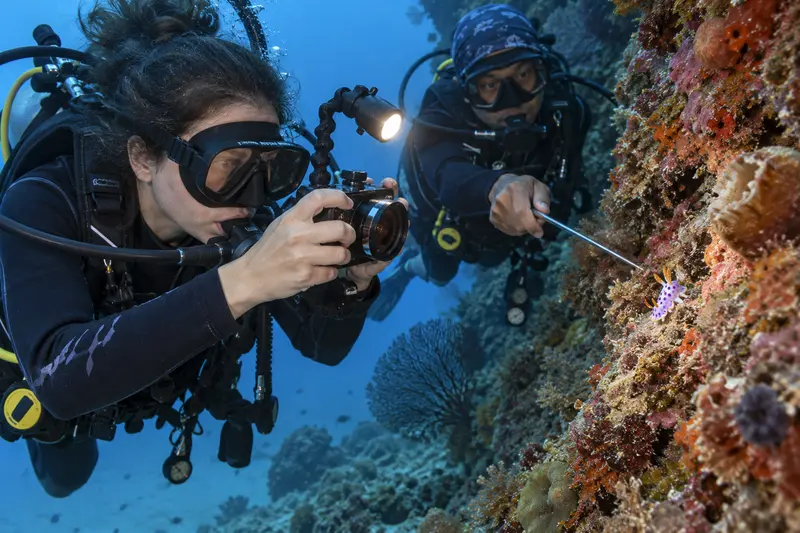
Slow buoyancy control matters more than distance covered. Nudibranch dives are usually close-looking dives.
Where do nudibranchs live?
Nudibranchs occur in oceans worldwide, from polar waters to tropical seas. Ocean Wise states that nudibranchs are found from the Arctic to Antarctica and can occur to 700 meters below the surface.
Most recreational divers look for them on the surfaces where nudibranch food is found. Depending on the species, food can include sponges, hydroids, bryozoans, tunicates, algae, corals, anemones and other nudibranchs. This is why good nudibranch dives are often slow searches over a small area instead of long-distance reef tours.
Water temperature and depth
There is no single water temperature for nudibranchs. The group includes animals from cold, temperate and tropical seas. For trip planning, use the destination water temperature to choose exposure protection, then look for habitats and food sources that match nudibranch behavior.
Depth is also species-specific. Nudibranchs can live from very shallow water to deep water, but recreational divers usually search within ordinary recreational diving depths. Shallow reefs, sheltered muck sites, night dives, walls, rubble slopes and tidepool zones can all produce sightings when the right food source is present.
Where to see nudibranchs on dive trips
The destinations below are practical starting points for divers who want nudibranch-focused dives. A destination being listed here is not a sighting promise. Nudibranch sightings depend on season, local site choice, guide skill, visibility, current, surge and how carefully the diver searches. Indonesian liveaboard routes that include these islands are listed on the Indonesia liveaboards page. For Raja Ampat timing, see the Raja Ampat seasonal diving guide.
| Destination | Why divers search there | Trip note |
|---|---|---|
| Lembeh Strait, Indonesia | Known in dive travel for muck and macro diving, with black sand, rubble and small subjects. | Plan slow macro dives, night dives and a guide who knows small subjects. |
| Anilao, Philippines | Frequently used by underwater photographers for macro and nudibranch-focused diving. | Often planned as a resort or shore-based macro trip rather than a classic liveaboard-only route. |
| Bali and Tulamben, Indonesia | Tulamben and nearby sites are used for small subjects, including nudibranchs. | Works well for shore diving, macro photography and slow reef or muck searches. |
| Raja Ampat, Indonesia | High reef biodiversity supports varied reef habitats. That does not make every dive a nudibranch dive. | Ask for macro time in addition to wide-angle reef and manta dives. |
| Komodo, Indonesia | Macro sites and rubble or reef habitats where operators report small subjects. | Some sites have current. Choose macro sites and suitable conditions, not only manta or current dives. |
| Temperate rocky reefs and tidepools | Nudibranchs are not only tropical. UK and Pacific coast sources document them in colder coastal waters. | Use local tide, shore and conservation rules. Do not remove animals from the site. |
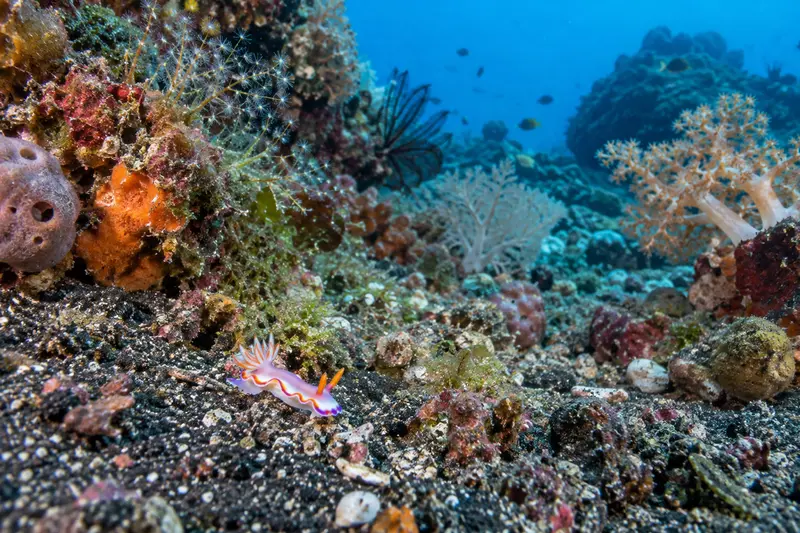
Look where the food is: sponges, hydroids, bryozoans, algae, tunicates, soft corals and shaded rubble can be more useful than open sand.
How to identify nudibranchs underwater
- Look for rhinophores. These paired sensory organs sit near the head and are one of the first features to check.
- Check the breathing structures. Dorids often show a rear gill plume. Aeolids show rows of cerata along the back.
- Record body shape. Note if the animal is oval, long, flattened, frilled, ridged, branched or covered with cerata.
- Record the substrate. Sponges, hydroids, algae, bryozoans, tunicates and soft corals can help narrow identification because many nudibranchs live near their food.
- Photograph from above and from the side. Divers Alert Network notes that identification photos should show the animal from above or laterally, with as much of the nudibranch in focus as possible.
- Do not touch or move it. Moving a nudibranch can separate it from its food source and can damage the animal or habitat.
- Use a regional guide. Color alone is not enough. Location, depth, size, body features and food source all matter.
How to search during a dive
Start by asking the guide which local food sources and substrates are producing sightings that week. Then slow the dive down. Instead of covering a whole reef, examine small areas carefully. Search vertical walls, overhang edges, sponge patches, hydroid growth, algae, rubble and sheltered areas with less surge.
Good buoyancy is part of the method. Divers who are stable can look sideways and underneath ledges without touching the reef. A small focus light can help with shadows, but avoid blasting the same animal for a long time.
What to log after the dive
- Dive site, destination, date and approximate depth.
- Approximate size in millimetres or centimetres.
- Body type: dorid, aeolid, other nudibranch, or sea slug not yet identified.
- Visible features: rhinophores, gill plume, cerata, mantle edge, color pattern.
- Substrate and possible food source.
- Photo angles: top, side and habitat view.
FAQ
Are all sea slugs nudibranchs?
No. Nudibranchs are one group of sea slugs. Sacoglossans, headshield slugs, sidegill slugs and sea hares are sea slugs but are not nudibranchs.
What depth do nudibranchs live at?
Nudibranchs occur from shallow water to deep water. Ocean Wise states that nudibranchs can be found below the surface at up to 700 meters deep. Recreational divers usually look for them in shallow and mid-depth reef, rubble, muck and wall habitats.
What temperature do nudibranchs need?
There is no single nudibranch water temperature. Nudibranchs occur from Arctic and Antarctic waters to tropical seas. Warm shallow waters have high diversity, but cold-water nudibranchs also exist.
How do divers identify nudibranchs underwater?
Divers should look at body shape, rhinophores, exposed gills or cerata, mantle edge, color pattern, food source, habitat and location. A photo from above and the side helps later identification.
Are nudibranchs rare?
Some species are rarely seen, but nudibranchs as a group are widespread. Smithsonian Ocean states that about 3,000 species are found from the poles to the tropics in shallow and deep water.
Are nudibranchs dangerous to divers?
Divers should not touch them. Many nudibranchs use chemical defenses, camouflage, warning colors or prey-derived defenses. The safer practice is to observe and photograph without contact.
Can beginners see nudibranchs?
Yes, if the dive site and conditions are suitable. Beginners need stable buoyancy before searching close to reef, rubble or muck habitats.
Are nudibranchs only found in warm water?
No. Nudibranchs occur from polar waters to tropical seas. Warm shallow waters have high diversity, but cold-water nudibranchs are documented.
Sources
Facts in this article are taken from public references. A destination list is habitat and trip-planning context, not a sighting promise.
- Smithsonian Ocean: collage of nudibranch colours (about 3,000 species, dorid and aeolid types, typical size)
- World Register of Marine Species: Nudibranchia (taxonomy)
- National Geographic: nudibranchs (size range)
- Ocean Wise: meet the nudibranch (worldwide habitat and depth to about 700 metres)
- Divers Alert Network: a quest for life (photograph from above or laterally for identification)
- Australian Museum Sea Slug Forum (meaning of nudibranch and historical photo archive)
- The Wildlife Trusts: what is a nudibranch (UK temperate context)