
When Is the Best Time to Dive Thailand? Seasons, Marine Life and Liveaboards
11 July 2026
Thailand is not one simple diving season.
That is the first thing I would tell a diver before they book. The Andaman Sea and the Gulf of Thailand do not behave the same way. A good month for Koh Tao can be the wrong month for the Similan Islands. A beautiful liveaboard route can be closed while another coast is still diving.
This Thailand seasonal diving guide is written for divers who want the real planning answer: when to go, what marine life is realistic, and when Thailand liveaboard diving makes sense.
Quick answer
For Thailand liveaboard diving, aim for the Andaman Sea season from mid-October to mid-May, with November to April usually the safest planning window. For Koh Tao and the Gulf of Thailand, diving is possible for much of the year, but November and December can be rough. If you care about marine life, plan around the region, not only the country name.
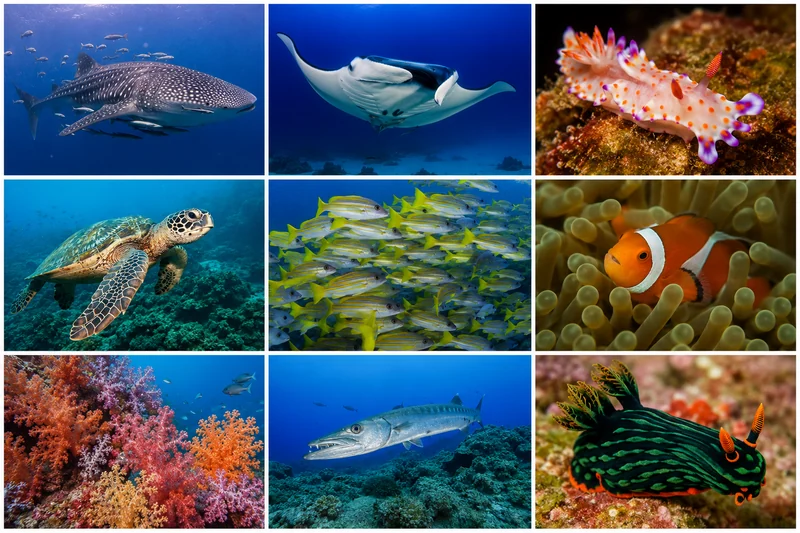
Divers in the Similan Islands. Thailand is seasonal, and the route matters more than the word "Thailand" on a booking page.
Quick season map
| Region | Main season | Best for | What to watch |
|---|---|---|---|
| Similan Islands, Koh Bon, Koh Tachai, Richelieu Rock | Mid-October to mid-May, strongest planning window November to April | Thailand liveaboard diving, clear water, reef fish, barracuda, turtles, macro, possible mantas and whale sharks | National park closures, current, route changes, late-season weather |
| Surin Islands and Richelieu Rock | Mid-October to mid-May | Richelieu Rock, fish schools, macro life, seahorses, nudibranchs, possible big animals | Open-ocean conditions and park closure dates |
| Koh Tao, Koh Samui, Koh Phangan | Can be dived much of the year | Training, turtles, reef fish, pinnacles, whale shark chances around April and May | November and December monsoon weather, site choice by conditions |
| Phuket, Phi Phi, Shark Point, King Cruiser area | Best in the drier Andaman months | Day boat diving, reef fish, soft coral, turtles, leopard shark possibilities, wreck diving | Visibility and current can change fast |
Thailand is two diving seasons, not one
The mistake is searching "best time to dive Thailand" and expecting one clean answer. Thailand has water on both sides. The Andaman Sea is where most Thailand liveaboards run. The Gulf of Thailand is where Koh Tao, Koh Samui and Koh Phangan sit.
For liveaboard diving, you are usually looking at the Andaman Sea: Similan Islands, Koh Bon, Koh Tachai, Surin Islands and Richelieu Rock. That is the route people mean when they talk about Thailand liveaboards.
For training, easy day boats and a longer backpacker-style island stay, many divers look at Koh Tao. It is not the same trip. It is not worse. It is just different.
Do not book Thailand because someone told you "it is always good." Ask which coast, which month, which sites and what the boat can realistically reach.
Best time for Thailand liveaboard diving
The main Thailand liveaboard season follows the Andaman Sea and the marine park opening window. Mu Ko Similan National Park is normally open from 15 October to 15 May and closed during the southwest monsoon season. Mu Ko Surin National Park has the same general opening window.
For a diver, that matters more than the brochure language. If the park is closed, your Similan or Richelieu Rock liveaboard is not going there. If the weather is changing, the operator may adjust the route.
My practical answer:
- November to April is the cleaner planning window for most Thailand liveaboard diving.
- December to April is often used for big-animal planning around mantas and whale shark chances.
- October can work, but it is a transition month. The park may reopen, but the sea is still settling.
- May can still have dives early in the month, but do not plan carelessly. Closures and weather matter.
- June to September is not the Similan liveaboard season. Look at the Gulf of Thailand instead.
Month-by-month Thailand diving guide
| Month | Best region to consider | Marine life and conditions | Diver note |
|---|---|---|---|
| January | Andaman Sea, Similans, Richelieu Rock | Good liveaboard season, reef fish, barracuda, turtles, macro life, manta possibilities | Book early. This is not the month to assume last-minute cabin choice will be good. |
| February | Andaman Sea | Strong liveaboard month, good visibility potential, pelagic chances increase | Good month for confident certified divers who want the classic Thailand liveaboard route. |
| March | Andaman Sea and Gulf pinnacles | Warm water, strong fish life, possible mantas and whale sharks in the right areas | Good month, but do not turn whale sharks into a promise. |
| April | Andaman Sea and Koh Tao area | Good whale shark month for Gulf pinnacles such as Chumphon Pinnacle, South West Pinnacle and Sail Rock; late Andaman season still possible | Hot, popular and worth planning, but check park dates and boat schedules. |
| May | Early month Andaman, Gulf of Thailand | Transition. Some whale shark chances continue, but Andaman parks close mid-month. | Do not book a Similan liveaboard without checking exact dates. |
| June | Gulf of Thailand | Koh Tao style diving, reef fish, turtles, macro life, training-friendly conditions when weather behaves | Better for day boats than Thailand liveaboards. |
| July | Gulf of Thailand | Koh Tao visibility can be strong in July to September; turtles, barracuda, reef fish and macro life | Good for divers who want water time rather than a liveaboard route. |
| August | Gulf of Thailand | Reef and pinnacle diving, turtles, nudibranchs, shrimps, schooling fish | Good month for Koh Tao, but watch local weather like a diver, not a tourist. |
| September | Gulf of Thailand | Often still a good Koh Tao window, with visibility reported strong in this period | Good for training or relaxed diving, not for Similan liveaboards. |
| October | Transition month | Andaman parks reopen from mid-October, but early trips can still feel like the season is waking up | Be flexible. Conditions can be good, but this is not peak certainty. |
| November | Andaman Sea | Similan and Surin season is back. Gulf weather can be poor around November and December. | Good liveaboard month. Not my first choice for Koh Tao if perfect visibility is the goal. |
| December | Andaman Sea | High season, good route options, possible mantas, strong reef life | Book early. This is classic Thailand liveaboard timing. |
What marine life is popular in Thailand?
Thailand is not only whale sharks and mantas. They get the marketing because they sell trips, but a good Thailand diving week is often built from smaller moments: a nudibranch tucked into a crack, a turtle chewing over the reef, a cloud of snapper moving around a pinnacle, a sea snake passing with no interest in your drama.
If you only look for the biggest animal, you may miss the dive.
Whale sharks
Whale sharks are the dream sighting in Thailand, but they are not a guarantee. In the Gulf of Thailand, April and May are often mentioned for whale shark chances around Chumphon Pinnacle, South West Pinnacle and Sail Rock. Around the Similan and Surin liveaboard routes, whale sharks are possible around sites such as Richelieu Rock, but you should treat them as a bonus, not the whole reason for booking.
This is the rule I would give a diver: choose Thailand because the route is good even without the whale shark. If it appears, beautiful. If it does not, you still had a real trip.
Manta rays
Mantas are one of the reasons divers look at Koh Bon, Koh Tachai, Richelieu Rock and the wider Andaman Sea. December to May is often used as the manta-focused season in Thailand, with December to April being the cleaner planning window for liveaboards.
Mantas need space. Do not chase them. Do not swim above them. Do not block their path. Stay calm, stay below or to the side, and let the animal decide if it wants to pass again. The best manta encounters usually happen when divers stop trying to own the moment.
Turtles
Turtles are one of the most loved Thailand sightings because they slow the whole dive down. Koh Tao is known for hawksbill and green turtle encounters, and turtles can also appear around reef sites in the Andaman Sea.
The important part is simple: do not touch them, do not crowd them, do not block the surface if they need air, and do not swim after them because your camera is not ready.
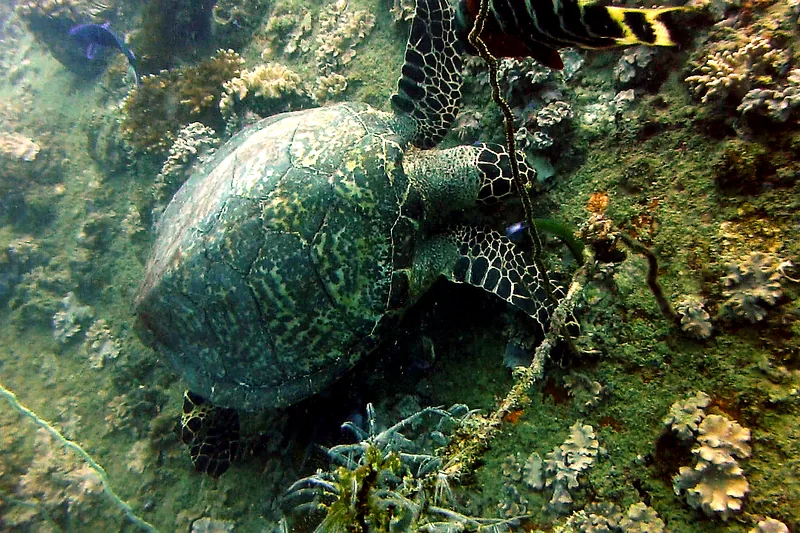
Turtles are common dream sightings in Thailand. The rule is not complicated: watch, breathe, give space.
Nudibranchs and macro life
Yes, Thailand has nudibranchs. And if you are the kind of diver who can slow down enough to see them, Thailand becomes much more interesting.
Nudibranchs, shrimps, seahorses, pipefish, frogfish and small reef creatures can be part of the dive, especially around sites with cracks, coral heads, artificial reef structures and protected corners. Richelieu Rock is often talked about for big life, but macro divers know it is also a place where small things can steal the dive.
Macro life is not seasonal in the same clean way as a park closure. It depends on site, guide, eyes, current, visibility and whether your group is rushing. If your guide swims like they are late for a ferry, you will miss half of it.
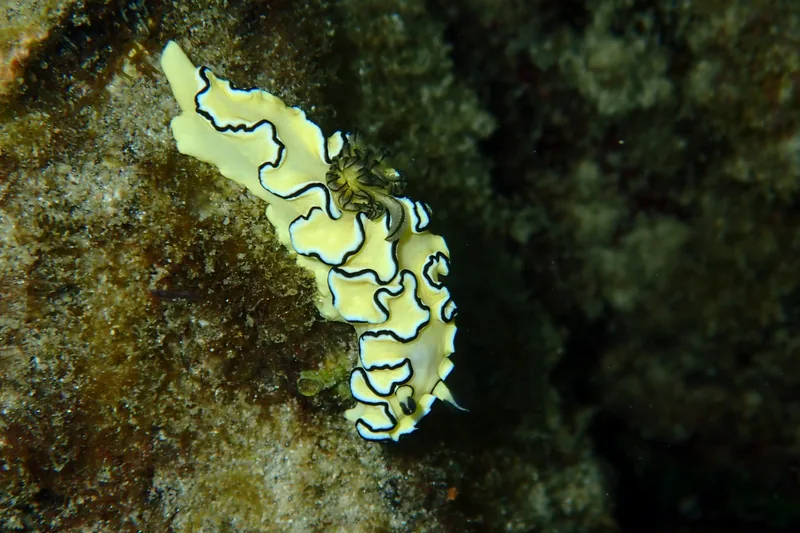
Thailand is not only big animals. Nudibranchs and other small life are part of what makes slower dives worth it.
Barracuda, trevally, snappers and reef fish
This is where Thailand can feel alive even without a headline animal.
Schools of barracuda, trevally, snappers, fusiliers and reef fish are a big part of the Andaman Sea experience. Richelieu Rock, Koh Tachai, Koh Bon and the Similan sites can give you that moving-wall-of-fish feeling when the conditions are right.
For me, this is one of the best reasons to choose a liveaboard. You are not just doing one famous site and leaving. You are moving through a route, seeing how the fish life changes from boulder sites to pinnacles to reefs.
Blacktip reef sharks, leopard sharks and other shark sightings
Thailand is not the Red Sea and it is not the Bahamas. Do not sell it to yourself as a shark-heavy destination if that is your main goal.
But sharks are possible. Blacktip reef sharks can be seen in some shallow areas, including around Koh Tao. Leopard sharks are associated with some Phuket and Phi Phi area sites such as Shark Point, although sightings can change over time and should never be sold as guaranteed.
If sharks are your reason for booking, look carefully at the exact destination and recent local reports. If you simply enjoy seeing reef life and accept sharks as a bonus, Thailand makes more sense.
Best Thailand diving for beginners
Koh Tao is the obvious answer for many new divers. Calm conditions, many dive schools, short boat rides and lots of training structure make it easy to understand why people start there.
But beginner-friendly does not mean careless. New divers still need a good briefing, good buoyancy, respectful wildlife behaviour and an operator that does not pack people into the water like luggage.
For a first Thailand liveaboard, I would want a diver to have:
- Open Water certification as the absolute minimum.
- Good buoyancy before they start chasing sites with current.
- Comfort getting on and off boats.
- A realistic idea of doing multiple dives per day.
- No need to prove anything with depth.
If the route includes stronger current, deeper pinnacles or night dives, Advanced Open Water and more logged dives make much more sense.
Best Thailand diving for liveaboard divers
Thailand liveaboards are strongest when they go to the Andaman Sea route: Similans, Koh Bon, Koh Tachai, Surin Islands and Richelieu Rock. This is where you get the feeling of a route, not just isolated day trips.
A good Thailand liveaboard can give you:
- multiple dives per day
- early access to sites before day boats arrive
- a mix of boulders, reefs, pinnacles and macro sites
- more time around sites like Richelieu Rock
- a better chance to see how conditions change through the trip
But a liveaboard is still not magic. If the sea is rough, the route can change. If the current is strong, the dive plan changes. If you are not comfortable with repetitive diving, you may be tired by day three.
That is not a reason not to go. It is a reason to choose the right boat and the right route for your level.
Should you choose Andaman Sea or Gulf of Thailand?
| Choose this | If your priority is | Good months to consider |
|---|---|---|
| Andaman Sea liveaboard | Similan Islands, Richelieu Rock, Koh Bon, Koh Tachai, route-based diving, big fish schools, possible mantas and whale sharks | November to April, with park window from mid-October to mid-May |
| Koh Tao and Gulf of Thailand | Training, relaxed island diving, turtles, reef fish, pinnacles, macro, whale shark chances at Gulf sites | Much of the year, with April-May for whale shark chances and July-September for strong visibility |
| Phuket and Phi Phi day boats | Easy access, day trips, mixed reef and wreck diving, Shark Point, King Cruiser, Anemone Reef area | Best planned in the drier Andaman months |
What I would not do
I would not book Thailand only because someone posted one whale shark video.
I would not book a Similan liveaboard in the closed season and hope the boat somehow goes there.
I would not choose a route above my level because the photos look better.
I would not touch turtles, chase mantas, kick coral for a nudibranch photo, or let a guide rush me past the small life because everyone is obsessed with big animals.
Thailand rewards divers who look properly. Not only divers who look for the biggest thing.
Best answer by diver type
First-time or newer diver: Koh Tao is often the easiest starting point. Focus on training quality, buoyancy and calm conditions.
Certified diver wanting a Thailand liveaboard: Similan Islands, Koh Bon, Koh Tachai, Surin and Richelieu Rock during the Andaman season.
Macro diver: Look for operators who understand slow diving. Nudibranchs, shrimps, seahorses and small reef life need time, not rushing.
Big-animal diver: Plan for the right season, but keep your expectations clean. Mantas and whale sharks are possible, not owed to you.
Photographer: Choose a route with site variety and an operator that gives good briefings, not just a list of famous names.
Final advice
The best time to dive Thailand depends on what kind of diving you want.
If you want Thailand liveaboard diving, look at the Andaman Sea season and plan around Similan, Surin, Koh Bon, Koh Tachai and Richelieu Rock.
If you want a longer island stay, training, turtles and Gulf pinnacles, Koh Tao can make more sense.
If you want marine life, do not only chase the calendar. Choose the region, the operator, the route and the dive style properly.
Thailand can give you whale sharks, mantas, turtles, nudibranchs, barracuda, reef fish, seahorses and slow beautiful dives where nothing headline-worthy happens, but you still come up smiling.
That is real diving. Not every dive needs a poster animal.
Compare Thailand liveaboardsFeatured Thailand liveaboards
A few Thailand liveaboards to start with, each shown with real, current prices from every provider that sells it:
FAQ
What is the best time to dive in Thailand?
For Thailand liveaboard diving in the Andaman Sea, November to April is the strongest planning window. The Similan and Surin national parks normally open from 15 October to 15 May. For Koh Tao and the Gulf of Thailand, diving is possible much of the year, with April and May often linked to whale shark chances and July to September often giving strong visibility.
When is the best time for Similan Islands liveaboards?
Plan Similan Islands liveaboards between November and April if you want the safer season choice. The park window normally runs from mid-October to mid-May, but the opening dates and weather should always be checked before booking.
What marine life can I see while scuba diving in Thailand?
Common and popular sightings include turtles, nudibranchs, shrimps, seahorses, moray eels, barracuda, trevally, snappers, fusiliers, titan triggerfish, sea snakes, reef fish, blacktip reef sharks and occasional manta rays or whale sharks.
Are whale sharks guaranteed in Thailand?
No. Whale sharks are possible in Thailand, especially around deeper Gulf pinnacles in April and May and around some Andaman sites in season, but they are never guaranteed. Do not choose a trip that only makes sense if a whale shark appears.
Is Thailand good for liveaboard diving?
Yes, especially in the Andaman Sea during the Similan and Surin season. Thailand liveaboards are best for divers who want route-based diving, multiple dives per day and access to sites such as Koh Bon, Koh Tachai and Richelieu Rock.
Related liveaboard diving guides
- What is a liveaboard and how to choose the right one
- Best time to book a liveaboard by destination and season
- Where to see whale sharks on a liveaboard
- Should I dive with Nitrox on a liveaboard?
Sources and planning notes
This guide uses destination and season references from PADI's Thailand diving season guide, PADI Koh Tao, Mu Ko Similan National Park information, Mu Ko Surin National Park information, Bluewater Dive Travel's Similan Islands guide, and local Richelieu Rock marine-life notes from Dive Richelieu Rock. Seasons, sightings and national park dates can change. Always confirm the exact route and current operating dates before booking.