
UNESCO marine diving sites: World Heritage and Biosphere Reserves
Updated 3 August 2026 · Reviewed from a diver and instructor perspective

The DiveScanner UNESCO underwater checklist includes World Heritage properties and Biosphere Reserves with established recreational diving access.
Baa Atoll is UNESCO. So are Galápagos, Komodo and Tubbataha. The label does not always mean the same thing. Some destinations are UNESCO World Heritage Sites. Others, including three Maldives atolls, are UNESCO Biosphere Reserves.
Quick answer
World Heritage Sites are recognised for outstanding universal natural or cultural value. Biosphere Reserves are living areas where conservation, research, local communities and sustainable use are managed together. Both can protect exceptional underwater environments.
This guide covers 28 UNESCO marine destinations with established recreational diving or a realistic dive-travel route. It is a diver-focused list, not a list of every coastal UNESCO designation on Earth. Some sites are reached by liveaboard, some by day boat, and a few are specialist expeditions.
UNESCO World Heritage vs UNESCO Biosphere Reserve
| World Heritage Site | Biosphere Reserve |
|---|---|
| Recognised under the World Heritage Convention for outstanding universal value. | Designated through UNESCO's Man and the Biosphere Programme. |
| The protected property's natural or cultural values are the central focus. | Conservation is combined with science, education, sustainable livelihoods and community participation. |
| Boundaries and protection commitments form part of the World Heritage listing. | Reserves normally use core, buffer and transition zones with different levels of activity. |
| Examples: Galápagos, Tubbataha, Socorro and the Great Barrier Reef. | Examples: Baa Atoll, Fuvahmulah, Raja Ampat and Wakatobi. |
Your UNESCO underwater checklist
Tick the destinations you have already explored. Your progress is saved only in this browser. No account is needed.
18 World Heritage dive destinations
10 Biosphere Reserves for divers
Best UNESCO liveaboard and dive trips at a glance
| Destination | UNESCO type | Access | Level | Main reason to go |
|---|---|---|---|---|
| Galápagos | World Heritage | Liveaboard | Advanced | Hammerheads and whale sharks |
| Komodo | World Heritage | Both | Varies | Mantas, coral and current |
| Tubbataha | World Heritage | Liveaboard | Advanced | Pristine walls and sharks |
| Socorro | World Heritage | Liveaboard | Advanced | Giant oceanic mantas |
| Cocos Island | World Heritage | Liveaboard | Advanced | Schooling hammerheads |
| Great Barrier Reef | World Heritage | Both | All levels | Huge route choice |
| Baa Atoll | Biosphere Reserve | Both | Varies | Mantas and whale sharks |
| Fuvahmulah | Biosphere Reserve | Island based | Advanced | Tiger sharks and pelagics |
| Raja Ampat | Biosphere Reserve | Both | Varies | Exceptional biodiversity |
| Wakatobi | Biosphere Reserve | Both | All levels | Healthy reef systems |
UNESCO World Heritage marine diving destinations
These properties are on the World Heritage List. Several protect large areas of open ocean, not only the islands or reefs visible above water.
Galápagos Islands, Ecuador
UNESCO World HeritageThe marine reserve around the Galápagos sits where major currents meet. Darwin and Wolf are the headline liveaboard sites, with schooling hammerheads and a strong chance of whale sharks in the cooler season.
- Access: Liveaboard for Darwin and Wolf
- Planning window: Year-round; whale shark season is usually June to November
- Experience: Advanced
- Underwater highlights: Hammerheads, whale sharks, marine iguanas, penguins, mola mola
Diver note: Expect current, blue-water entries, cooler thermoclines and repetitive deep profiles. This is not a first liveaboard for a newly certified diver.
Compare Galápagos liveaboards on DiveScanner.
Komodo National Park, Indonesia
UNESCO World HeritageKomodo combines manta cleaning stations, coral gardens and narrow channels where water can move fast. The UNESCO property protects both the famous islands and a highly productive marine system.
- Access: Liveaboard or day boat from Labuan Bajo
- Planning window: Year-round; many liveaboards favour April to November
- Experience: Open Water to advanced, route dependent
- Underwater highlights: Mantas, reef sharks, current-swept pinnacles, coral, macro life
Diver note: Central Komodo offers more flexible diving. Northern and southern current sites need stronger buoyancy, negative-entry confidence and good situational awareness.
Compare Indonesia liveaboards, including Komodo.
Tubbataha Reefs Natural Park, Philippines
UNESCO World HeritageTubbataha lies in the middle of the Sulu Sea and protects three atolls, deep water and exceptionally intact reef systems. The limited season is dictated by sea conditions.
- Access: Liveaboard only from Puerto Princesa
- Planning window: Short operating season, normally mid-March to mid-June
- Experience: Advanced recommended
- Underwater highlights: Pristine walls, reef sharks, tiger sharks, turtles, schooling fish
Diver note: Open-ocean exposure and current make experience important. Boats normally require strong buoyancy and a sensible number of logged dives.
Sanganeb and Dungonab Bay, Sudan
UNESCO World HeritageThis Red Sea World Heritage property links the isolated Sanganeb atoll with Dungonab Bay and Mukkawar Island. It contains reefs, mangroves, seagrass and important habitat for large marine life.
- Access: Expedition liveaboard from Port Sudan when operations are available
- Planning window: Conditions are often best in spring and autumn
- Experience: Advanced
- Underwater highlights: Coral walls, hammerheads, mantas, turtles, dugong habitat
Diver note: Access can change quickly. Check current travel advice, operator status and insurance coverage before planning.
Archipiélago de Revillagigedo (Socorro), Mexico
UNESCO World HeritageSocorro, San Benedicto, Roca Partida and Clarión rise from a submerged volcanic range. The islands are known for close encounters with giant oceanic mantas and other pelagic animals.
- Access: Liveaboard only from Cabo San Lucas or San José del Cabo
- Planning window: Typical liveaboard season is November to May
- Experience: Advanced
- Underwater highlights: Giant oceanic mantas, dolphins, hammerheads, Galápagos sharks, humpbacks
Diver note: The crossing is long and the diving is exposed. Current, surge and blue water make this a poor choice for weak buoyancy or limited experience.
Compare Socorro liveaboards on DiveScanner.
Cocos Island National Park, Costa Rica
UNESCO World HeritageCocos is more than 500 km from mainland Costa Rica. Its current-rich seamounts and cleaning stations attract large pelagic animals and make it one of the best-known shark destinations in the world.
- Access: Liveaboard only from Puntarenas
- Planning window: Year-round; calmer months and rainier months offer different conditions
- Experience: Advanced
- Underwater highlights: Schooling hammerheads, rays, tuna, dolphins, whitetip reef sharks
Diver note: Expect a long crossing, repetitive current dives and limited shelter. Operators usually ask for substantial experience.
Belize Barrier Reef Reserve System, Belize
UNESCO World HeritageThe UNESCO property is a network of seven protected areas, including the Blue Hole, Half Moon Caye, Glover's Reef and South Water Caye. It offers a wide range of reef and wall diving.
- Access: Resort, day boat or liveaboard
- Planning window: Year-round; the drier period is usually November to May
- Experience: Open Water to advanced
- Underwater highlights: Walls, atolls, reef sharks, turtles, rays, Great Blue Hole
Diver note: The Blue Hole is only one dive and is not the best reason to choose Belize. The outer atolls and walls provide the stronger overall liveaboard experience.
Great Barrier Reef, Australia
UNESCO World HeritageThe Great Barrier Reef is the largest coral reef system on Earth. Its size means the experience changes greatly between inner reefs, outer reefs, Ribbon Reefs and the Coral Sea.
- Access: Day boat, overnight boat or liveaboard
- Planning window: Year-round; many divers favour the drier months from May to October
- Experience: Beginner to advanced
- Underwater highlights: Coral reefs, dwarf minke whales, turtles, reef sharks, potato cod
Diver note: Choose the exact route, not only the destination name. A short day trip and a multi-night Ribbon Reef itinerary are completely different products.
Rock Islands Southern Lagoon, Palau
UNESCO World HeritagePalau's Rock Islands sit inside a barrier reef and contain channels, caves, arches and marine lakes. The best-known dives use current to bring sharks and schooling fish onto the reef edge.
- Access: Day boat or liveaboard from Koror
- Planning window: Year-round; the drier period is commonly December to April
- Experience: Intermediate to advanced for current sites
- Underwater highlights: Blue Corner, channels, sharks, mantas, caves, marine lakes
Diver note: A reef hook may be used where local rules allow it. Divers need control in current and must follow the guide's positioning instructions.
Ningaloo Coast, Australia
UNESCO World HeritageNingaloo is a long near-shore reef on Western Australia's remote coast. It is famous for seasonal whale shark encounters and easy access to coral from the shoreline.
- Access: Mostly shore and day-boat diving; some expedition options
- Planning window: Whale sharks usually gather from March to July
- Experience: Open Water to advanced
- Underwater highlights: Whale sharks, manta rays, turtles, reef life, humpback whales
Diver note: Many whale shark trips are snorkelling experiences. Scuba planning should also include reef dives, Exmouth or Coral Bay logistics and realistic travel distances.
Lagoons of New Caledonia, New Caledonia, France
UNESCO World HeritageSix marine clusters protect one of the world's largest and most structurally diverse reef systems. The lagoons connect mangroves, seagrass, reef flats, passes and outer slopes.
- Access: Shore and day-boat diving; expedition access varies
- Planning window: Diveable year-round, with seasonal changes in wind and water temperature
- Experience: Open Water to advanced
- Underwater highlights: Barrier reefs, passes, sharks, turtles, dugongs, large reef fish
Diver note: The property is geographically large. Confirm which UNESCO lagoon cluster your itinerary actually visits.
Lord Howe Island Group, Australia
UNESCO World HeritageLord Howe combines temperate and tropical species around a remote volcanic island. The surrounding reefs and seamounts hold unusually high endemism.
- Access: Island-based day boats
- Planning window: The main dive season generally runs through the warmer months
- Experience: Open Water to advanced
- Underwater highlights: World's southernmost true coral reef, endemic fish, Ball's Pyramid
Diver note: Visitor numbers and transport are limited. Book flights, accommodation and diving together rather than treating them as separate decisions.
Fernando de Noronha and Atol das Rocas, Brazil
UNESCO World HeritageThe World Heritage property joins Fernando de Noronha with the protected Atol das Rocas. Recreational diving is centred on Fernando de Noronha, while access to Rocas is tightly controlled.
- Access: Island-based diving at Fernando de Noronha; Atol das Rocas access is restricted
- Planning window: Conditions vary; late dry-season months often bring strong visibility
- Experience: Intermediate to advanced
- Underwater highlights: Dolphins, sharks, turtles, volcanic formations, clear water
Diver note: Current and surge can be strong. Environmental fees, park rules and daily site decisions are part of the trip.
Malpelo Fauna and Flora Sanctuary, Colombia
UNESCO World HeritageMalpelo is a remote oceanic rock surrounded by deep water, walls, caves and tunnels. UNESCO describes it as a world-class diving destination with major aggregations of large predators.
- Access: Specialist liveaboard only
- Planning window: Year-round, with major changes in visibility and current
- Experience: Expert
- Underwater highlights: Large hammerhead schools, silky sharks, whale sharks, steep walls
Diver note: This is technical in feel even when the dives remain recreational. Strong current skills, negative entries and disciplined group procedures are essential.
Coiba National Park, Panama
UNESCO World HeritageCoiba protects a large island group and marine zone in the Gulf of Chiriquí. It forms part of the Eastern Tropical Pacific corridor used by sharks, turtles, cetaceans and pelagic fish.
- Access: Day boat from the Pacific coast or expedition boat
- Planning window: The dry season, roughly December to April, is a common planning window
- Experience: Intermediate to advanced
- Underwater highlights: Sharks, rays, turtles, schooling fish, whale sharks seasonally
Diver note: Visibility can change quickly with plankton and tides. The strongest dives are not always the clearest ones.
Islands and Protected Areas of the Gulf of California, Mexico
UNESCO World HeritageThis serial World Heritage property includes islands and marine zones throughout the Sea of Cortez, including Bahía de Loreto and Cabo Pulmo.
- Access: Day boat or liveaboard, depending on region
- Planning window: September to November is a popular Sea of Cortez liveaboard window
- Experience: Open Water to advanced
- Underwater highlights: Sea lions, whale sharks, mobulas, dolphins, reefs, wrecks
Diver note: The UNESCO property is not one single route. Check whether the itinerary visits the protected component you want to see.
iSimangaliso Wetland Park - Maputo National Park, South Africa and Mozambique
UNESCO World HeritageThe transboundary property now combines iSimangaliso in South Africa with Maputo National Park in Mozambique. Its protected systems run from coral reefs and beaches to wetlands, mangroves and savannah.
- Access: Day-boat diving, mainly from Sodwana Bay and southern Mozambique
- Planning window: Year-round, with seasonal shifts in water temperature and wildlife
- Experience: Intermediate
- Underwater highlights: Coral reefs, turtles, whale sharks, dolphins, migrating whales
Diver note: Surf launches and open-ocean conditions can be physically demanding even when the reef dive itself is straightforward.
Socotra Archipelago, Yemen
UNESCO World HeritageSocotra is globally important for both terrestrial endemism and marine diversity. Its isolation creates a distinctive mix of Indian Ocean, Arabian and East African species.
- Access: Specialist expedition only when conditions permit
- Planning window: Seasonal monsoon winds strongly control access
- Experience: Advanced
- Underwater highlights: Endemic marine life, reef fish, coral, remote seascapes
Diver note: Current security and government travel advice must come before dive planning. Insurance exclusions and transport reliability can make a trip impossible even when a boat is advertised.
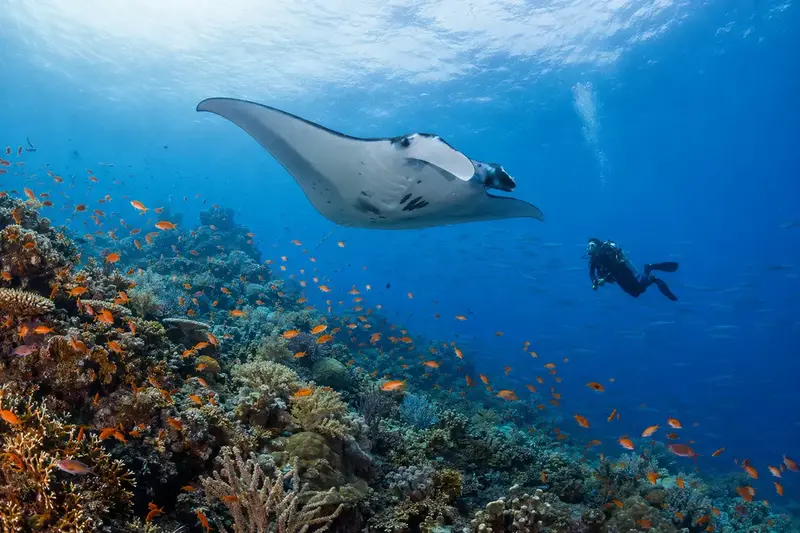
UNESCO Biosphere Reserves for scuba divers
Biosphere Reserves are not second-class UNESCO sites. They use a different model. The aim is to protect biodiversity while supporting research, education, local communities and sustainable economic activity.
Baa Atoll, Maldives
UNESCO Biosphere ReserveBaa Atoll became a UNESCO Biosphere Reserve in 2011. It protects a large reef system and is best known for plankton-driven manta gatherings around Hanifaru Bay.
- Access: Resort or liveaboard
- Planning window: Manta season is usually strongest from May to November
- Experience: Open Water to advanced
- Underwater highlights: Reef mantas, whale sharks, coral reefs, turtles
Diver note: Hanifaru Bay is managed mainly as a snorkelling site and scuba diving is not permitted inside the bay. Liveaboards dive other Baa Atoll reefs and channels.
Compare Maldives liveaboards on DiveScanner.
Addu Atoll, Maldives
UNESCO Biosphere ReserveAddu is the southernmost atoll of the Maldives and has been a UNESCO Biosphere Reserve since 2020. Its heart-shaped lagoon, channels, wetlands and outer reefs form a very different trip from the central atolls.
- Access: Resort or liveaboard
- Planning window: Year-round, with monsoon-dependent current and visibility
- Experience: Intermediate to advanced
- Underwater highlights: Mantas, eagle rays, turtles, channels, British Loyalty wreck
Diver note: Channel dives can run fast. Check whether an itinerary includes the wreck and manta cleaning stations or only uses Addu as an embarkation point.
Fuvahmulah, Maldives
UNESCO Biosphere ReserveFuvahmulah is a single-island atoll with no sheltered lagoon. Deep ocean surrounds the island, bringing large pelagic animals close to the reef.
- Access: Island-based diving
- Planning window: Year-round, with seasonal changes in pelagic species and visibility
- Experience: Advanced
- Underwater highlights: Tiger sharks, thresher sharks, oceanic mantas, whale sharks
Diver note: This is exposed diving with deep water immediately offshore. Ask operators directly about wildlife-interaction practices and choose trips that do not rely on feeding or baiting.
Compare Maldives trips and check whether the route reaches the deep south.
Raja Ampat, Indonesia
UNESCO Biosphere ReserveRaja Ampat joined UNESCO's World Network of Biosphere Reserves in 2025. Its marine area covers a vast archipelago at the centre of the Coral Triangle.
- Access: Liveaboard or eco-resort
- Planning window: Many liveaboards operate from October to April
- Experience: Open Water to advanced, route dependent
- Underwater highlights: Exceptional coral diversity, mantas, schooling fish, macro life
Diver note: Do not treat Raja Ampat as one uniform route. Dampier Strait, Misool and the northern islands differ in current, travel time and wildlife.
Wakatobi, Indonesia
UNESCO Biosphere ReserveWakatobi protects a large marine area around the Tukang Besi Archipelago. Its name comes from Wangi-Wangi, Kaledupa, Tomia and Binongko.
- Access: Resort, local boat or liveaboard
- Planning window: Diveable year-round; weather and crossings vary
- Experience: Open Water to advanced
- Underwater highlights: Coral gardens, walls, turtles, reef fish, macro life
Diver note: The strongest appeal is reef quality and biodiversity rather than one headline pelagic encounter. It suits divers who value long, careful reef dives.
Seaflower, Colombia
UNESCO Biosphere ReserveSeaflower is a vast Caribbean Biosphere Reserve covering islands, banks, shoals and open ocean. It contains most of Colombia's coral reef area.
- Access: Island-based diving around San Andrés and Providencia
- Planning window: Year-round, with Caribbean weather patterns
- Experience: Open Water to advanced
- Underwater highlights: Barrier reefs, walls, sharks, turtles, seagrass and mangroves
Diver note: San Andrés and Providencia offer different experiences. Confirm transport and local recovery status before planning around Providencia.
Banco Chinchorro, Mexico
UNESCO Biosphere ReserveBanco Chinchorro is Mexico's largest platform reef complex. Its isolation has helped preserve extensive reef, seagrass and mangrove habitats.
- Access: Expedition day boat or multi-day trip from southern Quintana Roo
- Planning window: Commonly planned in the calmer dry-season months
- Experience: Intermediate to advanced
- Underwater highlights: Remote atoll reef, wrecks, coral, sharks, turtles
Diver note: Crossings can be long and weather-sensitive. Some famous wildlife encounters in the reserve are snorkelling or surface experiences, not scuba dives.
Isla Cozumel, Mexico
UNESCO Biosphere ReserveCozumel became a UNESCO Biosphere Reserve in 2016. Its marine zone forms part of the Mesoamerican Reef and supports more than a thousand marine species.
- Access: Day-boat diving
- Planning window: Year-round; winter fronts can occasionally interrupt operations
- Experience: Open Water to advanced
- Underwater highlights: Drift diving, walls, swim-throughs, endemic splendid toadfish
Diver note: The current usually does the navigation. Good buoyancy and calm separation procedures matter more than swimming strength.
La Palma, Spain
UNESCO Biosphere ReserveThe La Palma Biosphere Reserve covers the entire Canary Island and a marine zone. Underwater, recent volcanic geology creates walls, lava formations and dark-sand slopes.
- Access: Shore and day-boat diving
- Planning window: Year-round, with warmer water in late summer and autumn
- Experience: Open Water to advanced
- Underwater highlights: Volcanic reefs, arches, black sand, rays, Atlantic fish
Diver note: Entry conditions can change with swell. Choose sites on the sheltered side of the island and use a local operator.
El Hierro, Spain
UNESCO Biosphere ReserveEl Hierro's Biosphere Reserve includes more marine area than land. The Mar de las Calmas and La Restinga are known for clear water and steep volcanic topography.
- Access: Shore and day-boat diving from La Restinga
- Planning window: Year-round; late summer and autumn are popular
- Experience: Intermediate
- Underwater highlights: Volcanic pinnacles, clear water, rays, groupers, pelagic visitors
Diver note: Current and swell can change site selection. The island rewards divers who are comfortable with deep walls and blue water.
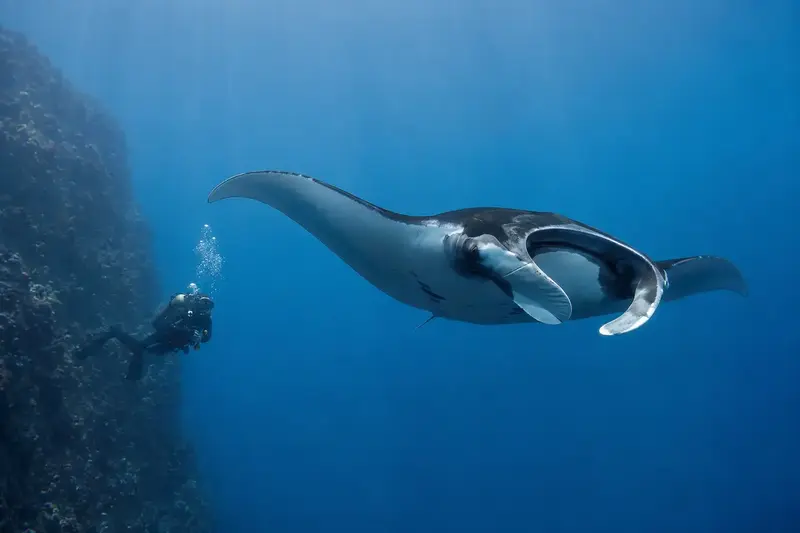
How to choose the right UNESCO dive destination
Choose by experience before wildlife. Galápagos, Cocos, Malpelo and Socorro are famous for big animals, but they demand current control, blue-water confidence and reliable buoyancy. A newer diver will normally get more from the Great Barrier Reef, Belize, Wakatobi or the easier parts of Komodo.
Check the exact protected component. Large serial properties such as the Gulf of California, Belize Barrier Reef and New Caledonia include several separate zones. A trip can use the UNESCO name without visiting the component you expected.
Separate scuba from snorkelling. Whale shark and manta programmes are sometimes surface encounters. Ningaloo whale shark trips and Hanifaru Bay manta visits are important examples.
Respect tighter rules. Protected status may bring permits, fixed moorings, no-entry zones, guide requirements and wildlife-distance rules. These are part of the trip, not an inconvenience to work around.
Responsible diving inside UNESCO marine sites
- Use fixed moorings where available. Never accept anchoring on coral.
- Do not touch, chase, ride or block marine animals.
- Avoid wildlife feeding and baiting. Choose operators that rely on natural encounters.
- Keep fins, gauges and cameras away from the reef.
- Follow local guide ratios, permit limits and no-entry zones.
- Report damaged moorings, illegal fishing or reef contact to the operator or park authority.
For more trip planning, read where to dive by month, compare reef and oceanic mantas, or check the guide to whale shark destinations and seasons.
UNESCO marine diving FAQ
What is the difference between a UNESCO World Heritage Site and a Biosphere Reserve?
World Heritage status recognises outstanding universal value under the World Heritage Convention. Biosphere Reserves belong to the Man and the Biosphere Programme and combine conservation, science, sustainable use and community participation.
Is Baa Atoll a UNESCO World Heritage Site?
No. Baa Atoll is a UNESCO Biosphere Reserve. It is a genuine UNESCO designation, but it comes from a different programme.
Which Maldives destinations are UNESCO Biosphere Reserves?
Baa Atoll, Addu Atoll and Fuvahmulah. Baa is best known for manta aggregations, Addu for channels and southern reefs, and Fuvahmulah for oceanic pelagic diving.
Which UNESCO dive sites require a liveaboard?
Tubbataha, Socorro, Cocos Island and Malpelo require a liveaboard or specialist expedition vessel. Darwin and Wolf in the Galápagos are also reached on liveaboard itineraries.
Which UNESCO destination is best for shark diving?
Galápagos, Cocos and Malpelo are leading hammerhead destinations. Socorro combines several shark species with giant oceanic mantas. Fuvahmulah is known for tiger sharks.
Are all UNESCO marine sites open for recreational diving?
No. Some areas are closed, permit-controlled, seasonal, research-only or affected by travel restrictions. Always verify the exact dive zone and current local rules.
Match the destination to your experience
Compare real liveaboard departures by destination, month, certification, logged dives and marine life. The wildlife filter is optional.
Search liveaboardsScope note: This is a diver-focused checklist of UNESCO World Heritage properties and UNESCO Biosphere Reserves with established recreational diving access or a realistic specialist expedition route. It is not a directory of every marine, coastal or island UNESCO designation worldwide.