
Where To Dive With Tiger Sharks
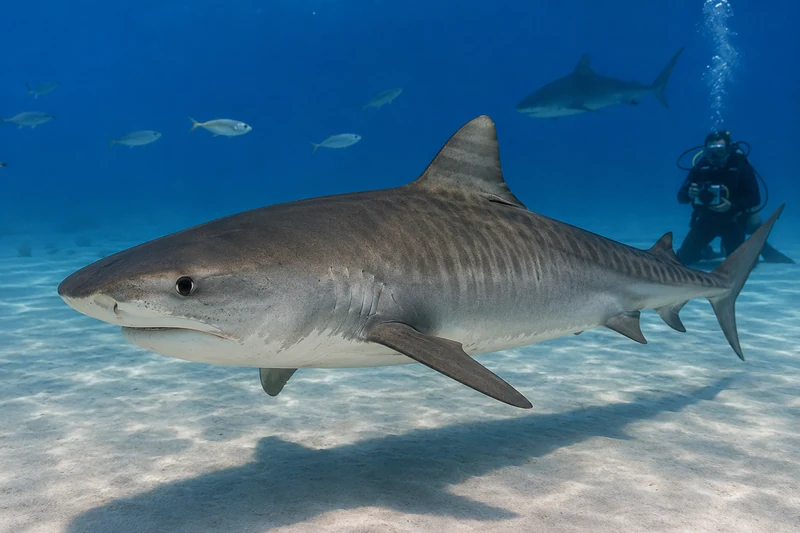
Tiger sharks are one of the strongest shark encounters a diver can have. They are large, calm-looking, powerful animals, and they should never be treated like props for a holiday photo.
This guide explains where to dive with tiger sharks, which destinations are most reliable, what diver level makes sense, and why DiveScanner does not recommend shark-feeding dives for entertainment.
Quick answer
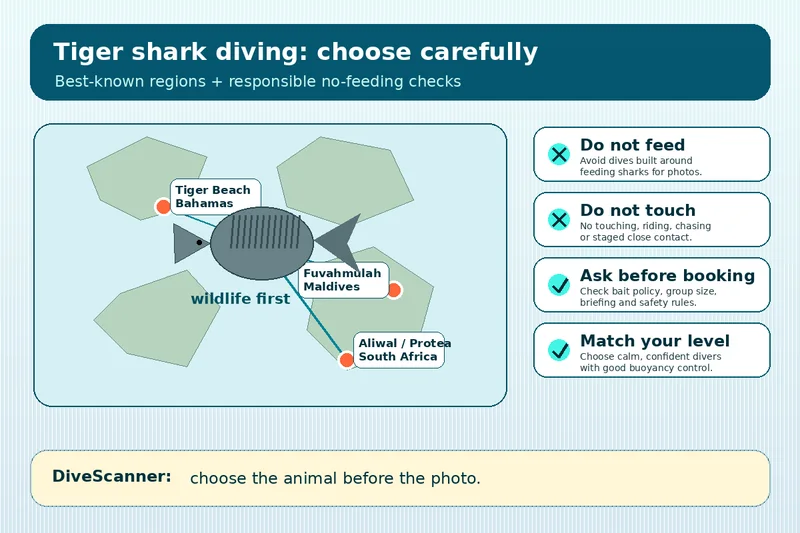
The best-known tiger shark diving destinations are Tiger Beach in the Bahamas, Fuvahmulah in the Maldives, and South Africa's Aliwal Shoal and Protea Banks. For liveaboard diving, the Bahamas and selected southern Maldives routes are the most relevant. For responsible diving, the operator matters as much as the destination.
Quick facts
| Species | Tiger shark, Galeocerdo cuvier |
|---|---|
| Best-known destinations | Tiger Beach, Bahamas; Fuvahmulah, Maldives; Aliwal Shoal and Protea Banks, South Africa. |
| Best trip style | Bahamas liveaboards for Tiger Beach, selected southern Maldives routes for Fuvahmulah, and day-boat shark diving in South Africa. |
| Diver level | Confident Open Water as an absolute minimum only in shallow calm conditions. Advanced Open Water and 30+ logged dives are a more sensible baseline. |
| Responsible rule | Do not choose operators that feed, touch, chase, crowd or stage tiger sharks for photos. |
Best tiger shark diving destinations
| Destination | Best for | Best season | Liveaboard relevance | Diver level |
|---|---|---|---|---|
| Tiger Beach, Bahamas | Classic tiger shark photography and shallow sand-flat encounters | Year-round sightings are promoted; October to January is often highlighted as stronger | High - Bahamas liveaboards visit Tiger Beach | Confident certified divers |
| Fuvahmulah, Maldives | Year-round tiger shark encounters and big pelagic diving | Year-round tiger sharks; other pelagics vary by season | Medium - only if the southern Maldives route includes Fuvahmulah | Advanced/confident divers recommended |
| Aliwal Shoal, South Africa | Shark diving, reefs, wrecks and big-animal conditions | Seasonal and condition-dependent | Low - usually day-boat diving | Advanced/confident divers |
| Protea Banks, South Africa | Open-ocean shark diving, current and deeper reefs | Seasonal and condition-dependent | Low - usually day-boat diving | Advanced divers |
1. Tiger Beach, Bahamas
Tiger Beach is the most famous tiger shark diving area in the world. It is known for shallow sand, clear water and close tiger shark encounters near Grand Bahama.
For liveaboard diving, this is the easiest tiger shark destination to connect with Bahamas itineraries. It is also the place most divers think of when they search for tiger shark diving.
But this destination needs a serious note. Some Tiger Beach operations use bait or feeding to bring sharks close. LiveAboard.com's Tiger Beach page openly describes sharks being lured with a crate of fish and divers lining up behind a feeder. That may create a predictable photo opportunity, but it is not the same thing as simply observing a wild animal passing through its habitat.
Do not book a shark dive only because it promises close tiger shark photos. Ask whether sharks are fed, baited, touched or staged before you pay. If the operation is built around feeding sharks for entertainment, choose another operator or another destination.
If you still choose Tiger Beach, ask clear questions: Do you feed the sharks? Do you use bait or chum? Are divers allowed to touch sharks? What is the maximum group size? What happens if a shark becomes agitated? Do you support local research or conservation?
2. Fuvahmulah, Maldives
Fuvahmulah is one of the strongest tiger shark destinations in the Indian Ocean. It is not the soft Maldives postcard version of diving. It is open-ocean diving with drop-offs, channels, blue water, pelagic life and serious shark encounters.
PADI describes Fuvahmulah as world-famous for year-round big-animal encounters, with tiger sharks present throughout the year. That makes it one of the most reliable places to plan a tiger shark trip if the route actually includes Fuvahmulah.
For DiveScanner, this destination is best for confident divers who want tiger sharks as part of a bigger pelagic diving profile: thresher sharks, hammerheads, oceanic manta rays and deeper blue-water conditions may also be part of the area.
The same responsible questions still apply. If the dive involves food waste, baiting or feeding near a harbour area, the operator should be transparent. Do not accept vague words like "natural encounter" without asking what attracts the sharks and what rules protect both divers and animals.
3. Aliwal Shoal, South Africa
Aliwal Shoal is a serious shark-diving area, not a soft first big-shark experience. The Marine Protected Areas South Africa guide describes Aliwal Shoal and its deep reefs as supporting scuba diving, ragged-tooth, tiger and blacktip sharks, wrecks and coral-covered fossilised dunes.
This is better for divers who already have control in current, understand boat procedures and are not going to panic when conditions change. It can be powerful diving, but it is not where I would send a nervous beginner for their first shark experience.
Aliwal Shoal is usually day-boat diving rather than liveaboard diving, but it belongs in this guide because it is an important tiger shark region and a serious shark-diving destination.
4. Protea Banks, South Africa
Protea Banks is another South African shark-diving hotspot. It is known for deeper offshore reef diving, drift conditions and different shark species depending on the season.
PADI's Protea Banks dive-site information lists possible close encounters with tiger sharks, hammerheads, blacktips, ragged-tooth sharks, bull sharks and giant guitar sharks. That makes it a strong shark destination, but not a simple beginner trip.
Expect current, blue-water procedures, changing visibility and stronger dive planning. If an operator offers baited dives, ask exactly what that means. A scent trail is different from hand-feeding, but you still need transparency, good briefing and strict animal-respect rules.
Should beginners dive with tiger sharks?
Not as a first serious shark dive.
Videos can make tiger shark dives look slow and controlled, especially when divers are kneeling or staying still on sand. But the mental pressure is real. You are sharing water with a large apex predator. You need calm breathing, good buoyancy, awareness and the ability to follow instructions immediately.
Minimum sensible recommendation:
- Advanced Open Water is better than basic Open Water.
- 30+ logged dives is a more realistic baseline.
- You should be comfortable with current, boat entries and blue water if the destination requires it.
- You should be able to stay still without chasing, drifting away or pushing forward for photos.
- You should not make the camera more important than the dive briefing.
Why I do not recommend shark-feeding dives
Feeding sharks for tourism is not the same as seeing sharks in their own rhythm.
When food is used to pull sharks close, the dive can become less about observation and more about control. The animal is no longer simply moving through its habitat. It is being brought into a human-made setup for a predictable encounter.
That is where the ethical problem starts.
Feeding or provisioning can change the relationship between sharks, boats and divers. It can increase competition around food, create unnatural close contact, and teach divers that wildlife should be managed for a better photo. Responsible shark and ray tourism guidance is clear on the basic diver rules: do not touch the animals, do not feed the animals, respect the environment and follow local marine protected area protocols.
My recommendation is simple: do not choose operators that feed sharks for entertainment. Do not choose dives where touching is allowed. Do not choose a guaranteed close-contact photo over the animal.
What about Cristina Zenato?
Cristina Zenato is one of the best-known shark professionals connected with the Bahamas. Her official profile describes a lifetime dedicated to exploration, education and conservation, and her work includes sharks, caves and scuba diving.
But do not use serious shark educators as an excuse for tourist feeding.
Years of shark behaviour knowledge, discipline and controlled specialist work are not the same as a holiday diver kneeling behind a feeder for a photo. The lesson is not "everyone can interact with sharks." The lesson is that shark interaction requires knowledge, time, control, respect and responsibility.
How to choose a responsible tiger shark dive
| Question to ask | Good answer | Red flag |
|---|---|---|
| Do you feed the sharks? | No, or a transparent explanation of exactly what is used and why. | "Yes, for better photos." |
| Can divers touch sharks? | No. | "Only if the shark comes close." |
| What is the group size? | Small, controlled groups with clear diver positioning. | Large groups crowding the same shark. |
| What is the diver level required? | Clear certification and experience guidance. | "Anyone can do it." |
| What is in the briefing? | Shark behaviour, body position, emergency response and no-chase rules. | A short photo-focused briefing. |
| What happens if the shark becomes agitated? | The guide has a clear protocol. | No clear answer. |
Best choice by diver type
For liveaboard diving and photography: Tiger Beach, Bahamas, but only if the operator's shark interaction rules are transparent and you are comfortable with how the encounter is managed.
For big pelagic diving: Fuvahmulah, Maldives, especially for confident divers who want tiger sharks as part of a wider big-animal trip.
For advanced shark divers: Aliwal Shoal and Protea Banks in South Africa, where conditions can be more demanding and less polished than brochure-style shark tourism.
For beginners: Build confidence first. Start with reef sharks, nurse sharks, turtles, rays and easier boat diving before choosing tiger sharks.
Final advice
The best place to dive with tiger sharks is not only the place with the most sharks.
It is the place where the encounter is managed with respect.
Tiger sharks do not need to be fed for us to admire them. They do not need to be touched for us to feel close to them. They do not need to be turned into a performance for a diver to remember the moment.
Choose the operator before the photo. Choose the animal before the marketing.
Planning a shark-focused liveaboard diving trip? Use DiveScanner to compare destinations, routes, seasons and diver-level requirements before you book.
Compare liveaboardsFAQ
Where is the best place to dive with tiger sharks?
Tiger Beach in the Bahamas and Fuvahmulah in the Maldives are the most famous tiger shark diving destinations. South Africa's Aliwal Shoal and Protea Banks are also strong shark-diving regions, but they are better for confident divers and are usually day-boat based.
Can beginners dive with tiger sharks?
I would not recommend tiger sharks as a first serious shark dive. Advanced Open Water, good buoyancy, calm breathing and 30+ logged dives are a better baseline, especially for Fuvahmulah, South Africa or any site with current.
Are tiger shark feeding dives ethical?
DiveScanner does not recommend shark-feeding dives for entertainment or close-contact photography. Choose operators that do not feed, touch, chase, crowd or stage sharks.
Can you see tiger sharks on a Maldives liveaboard?
Only on the right route. Some southern Maldives liveaboards may include Fuvahmulah or nearby big-animal areas, but a general Maldives liveaboard does not automatically mean tiger sharks.
When is the best time for Tiger Beach in the Bahamas?
Tiger Beach is commonly promoted as a year-round tiger shark site, with October to January often described as the strongest period. Always check the operator's current season notes and shark-interaction rules before booking.
Related liveaboard diving guides
- Where to see whale sharks on a liveaboard
- Best time to book a liveaboard by destination and season
- Advanced liveaboard routes: certification, depth and insurance checks
- Famous Red Sea wreck dives: SS Thistlegorm and Salem Express
Sources and responsible planning notes
This guide uses current destination information from LiveAboard.com Tiger Beach, PADI Fuvahmulah, PADI Protea Banks, Marine Protected Areas South Africa, PADI AWARE responsible shark and ray tourism guidance, CMS Sharks responsible tourism guide, Shark Trust code-of-conduct principles and Cristina Zenato's official shark education profile. Sightings and operator practices change. Always check the exact itinerary, season and shark-interaction policy before booking.