
Quick answer
Menstruation itself does not automatically make recreational scuba diving unsafe. DAN says there is no reason a menstruating diver should not dive when the menstrual cycle is not causing symptoms or discomfort that affect health.
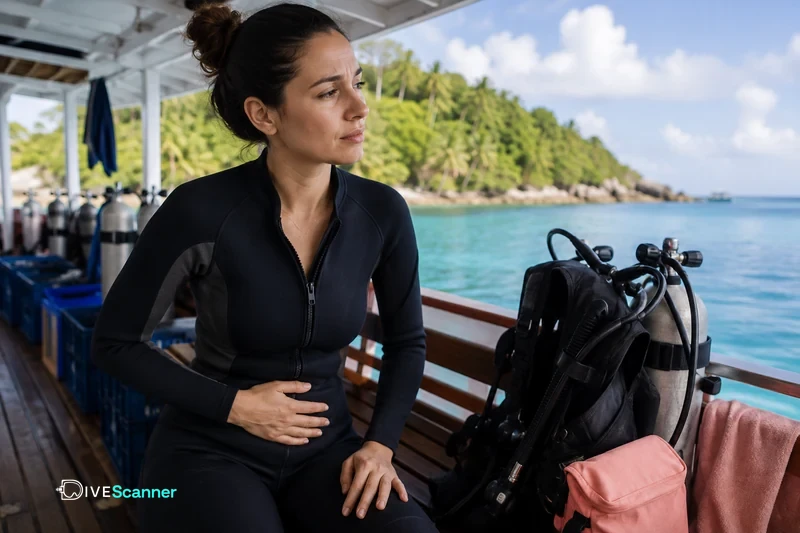
The decision changes when symptoms change the diver. Cramps, PMS, headache, fatigue, bloating, lower alertness, stress, poor focus, nausea, pain, bad sleep, messy buoyancy or much faster breathing can all make a dive harder to manage.
What the research says
DAN lists PMS symptoms that matter to diving: mood changes, irritability, decreased mental alertness, tension, fatigue, depression, headaches, bloating, swelling, breast tenderness, joint pain and food cravings. DAN also says menstruation does not seem to be a problem as long as normal vigorous exercise does not increase symptoms.
DAN Europe is more direct about the dive profile. It says menstruating divers should be aware of how PMS and menstruation affect them, and advises more conservative dive profiles. Their examples include no decompression stops, no more than two dives a day, maximum depth within 30 metres, and bottom time within 70 to 75 percent of the maximum limit.
That does not create a rule that all menstruating divers must stay shallow. It supports a practical rule: when symptoms affect the diver, make the dive easier.
Deep research summary for divers
Scuba specific evidence is limited. The clearest diving guidance comes from DAN and DAN Europe. Both focus on symptoms and conservative decisions, not a blanket ban.
Depth still matters. DAN explains that deeper dives have stronger physiological effects, inert gas accumulates more, and breathing gas depletes faster. If your period already raises air consumption or lowers focus, depth removes margin.
Buoyancy affects workload. DAN and StatPearls both connect poor buoyancy with higher air use, fatigue and dive risk. If your period changes trim or weighting, fix that before choosing a demanding dive.
Exercise medicine supports easing intensity. NHS, Cochrane, Japanese sources and Chinese public health sources support light or moderate activity for many people with period pain, while reducing intensity when symptoms are present.
Take it easier, not off the trip
Your period does not have to cancel your liveaboard. It may only change how you use the first day or two.
Think about training. Some days are for heavy weights. Some days are for stretching, mobility and a slower pace. Diving can work the same way.
If cramps, fatigue, focus, buoyancy or air consumption change, choose the easier version of the dive plan. A shallow reef instead of a deep wall. A calm mooring dive instead of strong current. A shorter dive. A higher turn pressure. More rest between dives.
You are still diving. You are just not pretending your body is a rental tank with unlimited gas.
Why shallower can be better on difficult period days
There is no rule that says you must stay shallow just because you are menstruating. If you feel normal, dive your normal plan.
If your period changes your breathing, focus, buoyancy or comfort, choose a dive with more margin. Shallower dives use gas more slowly, reduce inert gas loading and give you more time to solve small problems before they become big ones.
On those days, skip the deep wall, strong current or navigation-heavy dive. Pick the reef, the easy route, the shorter profile. The liveaboard is not a punishment schedule.
Pressure underwater, effort and gas use
Scuba gas use changes with depth because the regulator delivers breathing gas at the surrounding water pressure. At about 10 metres, a diver breathes gas at roughly twice surface pressure. At about 20 metres, it is roughly three times surface pressure. The exact tank pressure change depends on the dive, but the direction is simple: deeper means faster gas use.
Depth is not the only factor. Effort also matters. Current, bad trim, overweighting, cold, stress, pain and anxiety can increase breathing. If period pain or PMS makes you tense, distracted or uncomfortable, the tank may empty much faster than on your normal easy dive.
Personal instructor note
For me, the first two days can change the dive completely. On a normal easy dive, with maximum depth around 20 metres and average depth around 12 metres, I can dive for about one hour and still come back with around 80 bar.
During my period, I can be close to out of air after 30 minutes. I may also need 0.5 kg to 1 kg more weight, and buoyancy feels messier than normal. Direction feels harder, even though navigation is usually not a problem for me. My stomach hurts, I feel tired, and my focus is not the same.
That is not a universal rule. It is a reason to track your own pattern and choose the dive that fits your body that day.
Buoyancy and weights during your period
Some divers feel bloated, tense or less stable in trim during their period. That can make buoyancy feel different even when the equipment is the same. The answer is not to throw lead on the belt and hope for a miracle.
Do a buoyancy check. If you need 0.5 kg or 1 kg more for the first period days, add it carefully. Keep your trim balanced. Too little weight can make the safety stop stressful. Too much weight can make you work harder, use more gas and fight your BCD all dive.
- Ask for 0.5 kg blocks if the boat has them.
- Spread small weights evenly.
- Check buoyancy at the surface with a nearly empty BCD and normal breath.
- Check trim underwater before the dive gets busy.
- Tell your buddy if you are adjusting weight or may be less stable than usual.
- Use the first dive of the day as the test dive, not the deep current dive.
What Japanese medical and sports sources add
Japanese Ministry of Health material treats menstrual pain and PMS as real health issues, not something to ignore. Japanese sports and obstetrics sources also recognise that menstruation can affect performance. The Japan Association of Obstetricians and Gynecologists advises athletes to consult a gynaecologist in advance when menstruation affects performance, because symptoms can be treated or the timing can be managed for important events.
For a diver, the useful point is planning. If your cycle predictably affects you, do not wait until the morning briefing. Choose route difficulty, depth and schedule with that pattern in mind.
What Chinese health sources add
Chinese public health and sports sources support suitable exercise during menstruation, but they also advise controlling the type, intensity and duration. Health China material recommends reducing intensity and choosing easier movement such as walking or light yoga when needed. The General Administration of Sport warns against very intense exercise and movements that raise abdominal pressure during menstruation.
Some Chinese public health pages are more conservative about swimming or water activity during menstruation. Scuba diving is not the same as casual pool swimming, and these sources are not written as scuba medicine guidance. For a liveaboard article, the safe takeaway is still useful: keep hygiene simple, use a period product you already trust, avoid pushing through severe symptoms, and reduce intensity when your body asks for it.
Period products on a liveaboard
Use what already works for you. A liveaboard is not the place to test a product for the first time.
- Tampons can be practical for diving. Pack more than you think you need.
- Menstrual cups work for many divers. Practise before the trip.
- Period swimwear may help on surface intervals, but think about drying time and rinsing.
- Pads are not useful inside swimwear or wetsuits during a dive, but they can help between dives.
- Pack disposal bags, hand sanitiser, spare underwear, pain relief you normally use, and a small dry bag.
Will sharks care?
There is no good evidence that menstruation increases shark attack risk for recreational divers. Shark myths should not decide your dive. Your symptoms, the conditions, your gas and your focus matter more.
When to change or skip the dive
Change the plan if you have:
- Strong cramps or pain that distracts you.
- Dizziness, faintness, nausea or unusual weakness.
- Headache or migraine symptoms.
- Unusual anxiety or poor focus.
- Very high air consumption compared with your normal pattern.
- Buoyancy problems that make depth control or safety stops stressful.
- Heavy bleeding that feels unmanageable on a boat day.
- Any symptom that would make you a less safe buddy.
How to plan the liveaboard
- Choose easier routes if your first period days are predictable.
- Pick shallower reef dives on symptom-heavy days.
- Use a higher turn pressure.
- Stay closer to the guide or boat.
- Avoid leading navigation if you feel foggy.
- Do fewer dives that day.
- Keep warm between dives.
- Drink water and eat properly.
- Tell your buddy the practical part: air may go faster, buoyancy may need checking, and you may want an easier profile.
How DiveScanner helps
If your period affects air use, buoyancy, focus or energy, route choice matters. A calm reef route with easy exits is not the same as a deep current itinerary where every dive expects advanced confidence.
Use DiveScanner to compare liveaboards by destination, month, price, marine life, certification and logged dives. If your cycle is predictable, choose dates and routes with more margin.
Choose the trip your body can enjoy
Compare liveaboards by destination, month, route difficulty, marine life, certification and logged dives before you book.
Compare liveaboardsFAQ
Can you scuba dive on your period? For many divers, yes. Menstruation itself is not usually a reason to avoid recreational scuba diving. Symptoms decide the dive plan.
Should I dive shallower on my period? Not automatically. If your breathing, buoyancy, focus or comfort changes, choose a shallower and easier dive.
Can PMS affect air consumption? Pain, stress, fatigue, cold and effort can all increase breathing. Some divers notice a large difference during the first period days.
Can I need more weight? Some divers report different buoyancy or trim. Do a buoyancy check and adjust in small steps, such as 0.5 kg to 1 kg, if needed.
Can I use a menstrual cup or tampon while diving? Many divers do. Use what you already trust, pack enough supplies and plan bathroom time between dives.
What if I paid for four dives a day? You paid for a trip, not a test of suffering. Skip one dive if your body needs rest.
Sources and useful reading
- Divers Alert Network: Women's Health and Diving
- DAN Alert Diver: Women's Health in Diving
- DAN Europe medical FAQ
- DAN: The Depth of the Matter
- DAN: The Importance of Buoyancy Control
- StatPearls, NCBI Bookshelf: Diving Buoyancy
- NHS: Period pain
- Cochrane: Exercise for dysmenorrhoea
- General Administration of Sport of China: exercise during special female life stages
- Health China repost: exercise during menstruation
- Japan Ministry of Health support site: menstruation
- Japan Association of Obstetricians and Gynecologists: menstruation and competition
- Juntendo University Female Sports Research Center
- Girls that Scuba: Can You Scuba Dive on Your Period?
Read next: Is liveaboard diving safe?, travel insurance for a liveaboard, and liveaboard visa requirements.